
#41. When brands stop solving problems, they start recognising opportunities
What if we stopped framing our work around challenges, and started framing it around opportunities instead?
I asked this not because challenges don’t exist – we all know they do! – but because focusing only on challenges limits our role as designers.
Today, what keeps a product or brand alive isn’t just how well it solves a problem. It’s how well that brand recognises what’s happening in the world around it. This recognition is fuel: used to create resonance and meaning.
This is storytelling as we know it today. And the very best stories start from opportunities.
The story of Punch: when readiness meets opportunity
The story of Punch, a baby macaque rejected by his mother, went viral.
A caretaker at the Japanese zoo where Punch was living brought him a stuffed toy, so he could find some comfort. Gambare Punch (in Japanese: “Keep going, hang in there, Punch!”) became the new hashtag.
That toy was later recognised as an IKEA product. Punch carried it everywhere: images of him hugging it moved people all over the internet. He was personalising emotions that everyone can relate to: the sadness of rejection, then finding comfort in something simple.
Particularly considering the world we live in, these are common human experiences (from which we have also seen the proliferation of psychology-based apps). The IKEA markets across Japan, Spain, the US, and Singapore saw an opportunity and jumped on it with both feet.
Did they promote their stuffed toy? Of course not! Instead, their ads used that toy’s symbolism to promote the values it had come to represent: family, reassurance, home, simplicity, and humanity.
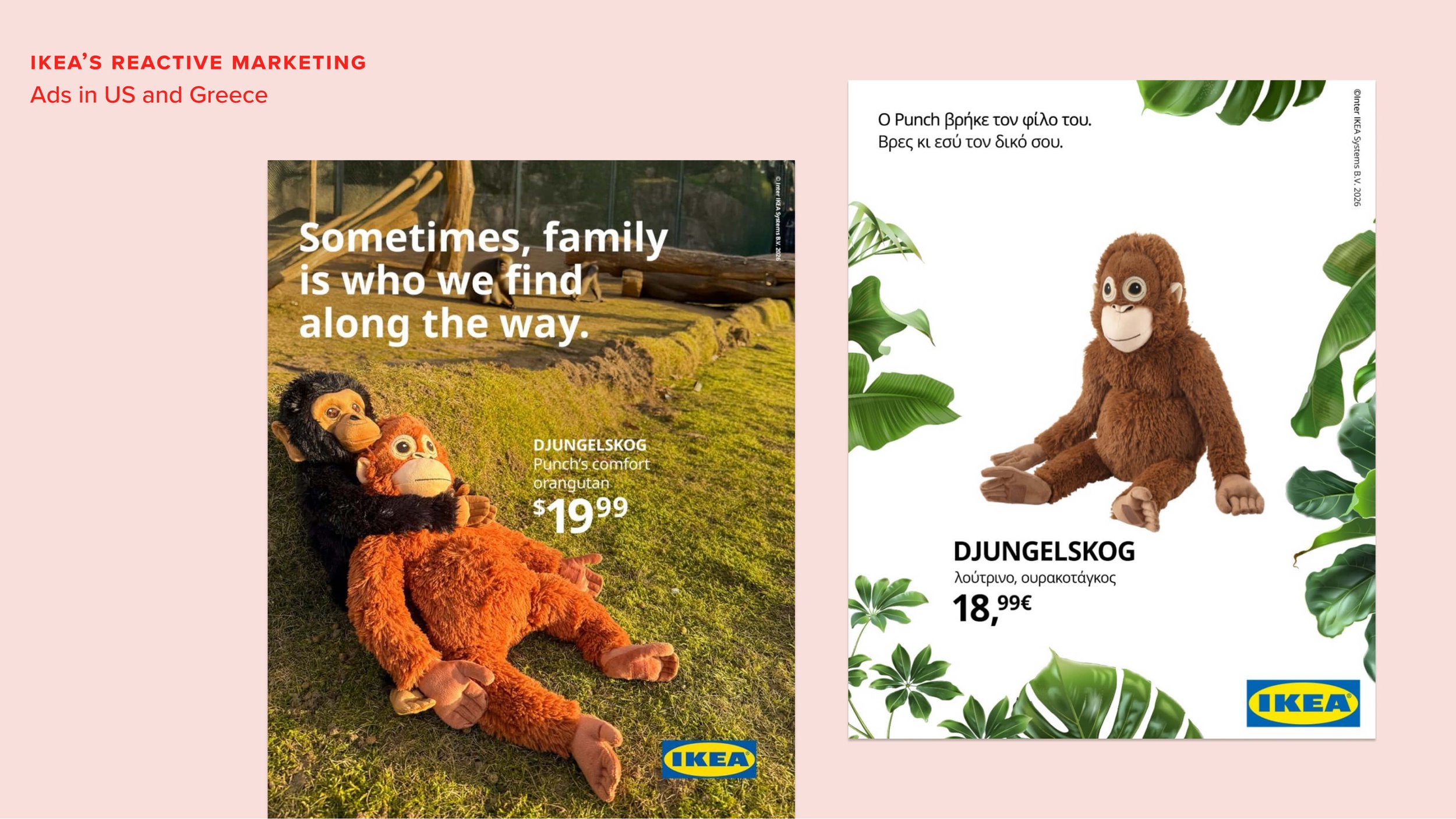
The IKEA advertising. Reactive marketing demands a brand to be prepared and firmly aligned with its values.
In a world that increasingly feels less compassionate, IKEA stood out with a story that wasn’t originally theirs, but became theirs. They then made it everyone’s story.
That’s what it means to recognise an opportunity. It means the brand is ready.
You may be wondering why IKEA wasn't hit with a torrent of criticism about taking advantage of Punch and his situation. But this is because the story was respected, and its clear brand values were aligned with those IKEA already stood for. Readiness is a brand strategy.
Something to learn:
Opportunities like this example can’t be planned. They emerge from real moments, real emotions, and real people (or in this case, a real macaque!). The role of a brand is not to create the story: it’s to recognise it, respect it, and step in only when it truly aligns.
The McDonald's Big Arch: when authenticity creates opportunity
A product can become viral for all the wrong reasons. Yet a smart brand will embrace those reasons and create a new story to relaunch itself in a higher space.
For example, in February 2026 McDonald’s launched the Big Arch burger with a promotional video of CEO Chris Kempczewski tasting it. Everybody hoped for a big hit, and that video obliged – just not in the way it had been planned.
Mr Kempczewski took an unconvincing bite of the “new product" (as he called it), and the backlash was immediate. “He was screaming for a kale salad!" as someone astutely commented on social media.
Burger King’s CEO leapt on the opportunity to show, on TikTok, how a Whopper should be eaten. He tried to ride the wave, but the attempt failed and no-one remembered that video. (See the Ryanair example explained below to understand why).
Meanwhile, that awkward McDonald’s video went viral. Instead of taking it down, the company leaned into its message. They recognised the awkwardness. They joined the conversation. They allowed the story to evolve.
And the result?
The Big Arch became visible far beyond its original launch plan.

McDonald’s ads. Instead of taking it down, the company leaned into its message.
McDonald’s built a story around authenticity. Not real strategy.
That launch video was genuine (it was the CEO in his office) and probably not well-scripted, as he could barely name the ingredients. Still, it showed the human side of one of the most powerful CEOs in the world, in front of a camera, looking slightly uncomfortable, just like most people would.
However, there is a limit to this approach. Building on irony or mockery has a short lifespan.
At some point the joke fades, and if the brand is laughing at its audience rather than with it, the story breaks down.
Think about Ryanair.
Their tone often plays with customer frustration, turning complaints into jokes. But those complaints are real, and the pain of many Ryanair customers is real.
When a brand uses humour to mask real problems (delays, lack of support, poor service), it stops feeling authentic and starts feeling dismissive.
Something to learn:
Opportunity is joining the conversation by admitting your own mistakes and shortcomings. That’s what makes a brand feel human and authentic.
Claude AI ads: a brand promise becomes an opportunity
This last example is taken from a short email exchange with Martin, one of my valued subscribers. In response to my last newsletter, Martin pointed out that Dyson isn’t a brand he would buy from, because of its CEO’s political position.
He asked me what I think about design in the context of a brand’s ethical and/or political stances.
Design is indeed political, and the episode involving Anthropic is probably the most recent example I can think of. It shows that people (if they are able to choose) can stand for the values and beliefs represented by their brand over how useful and necessary the product is.
In September 2025, Claude/Anthropic released a campaign, named “Keep Thinking", that tried to shed light on a world that is increasingly AI-compliant.
The campaign stood on the side of what makes humanity unique: independent thinking, discerning one thing from another.
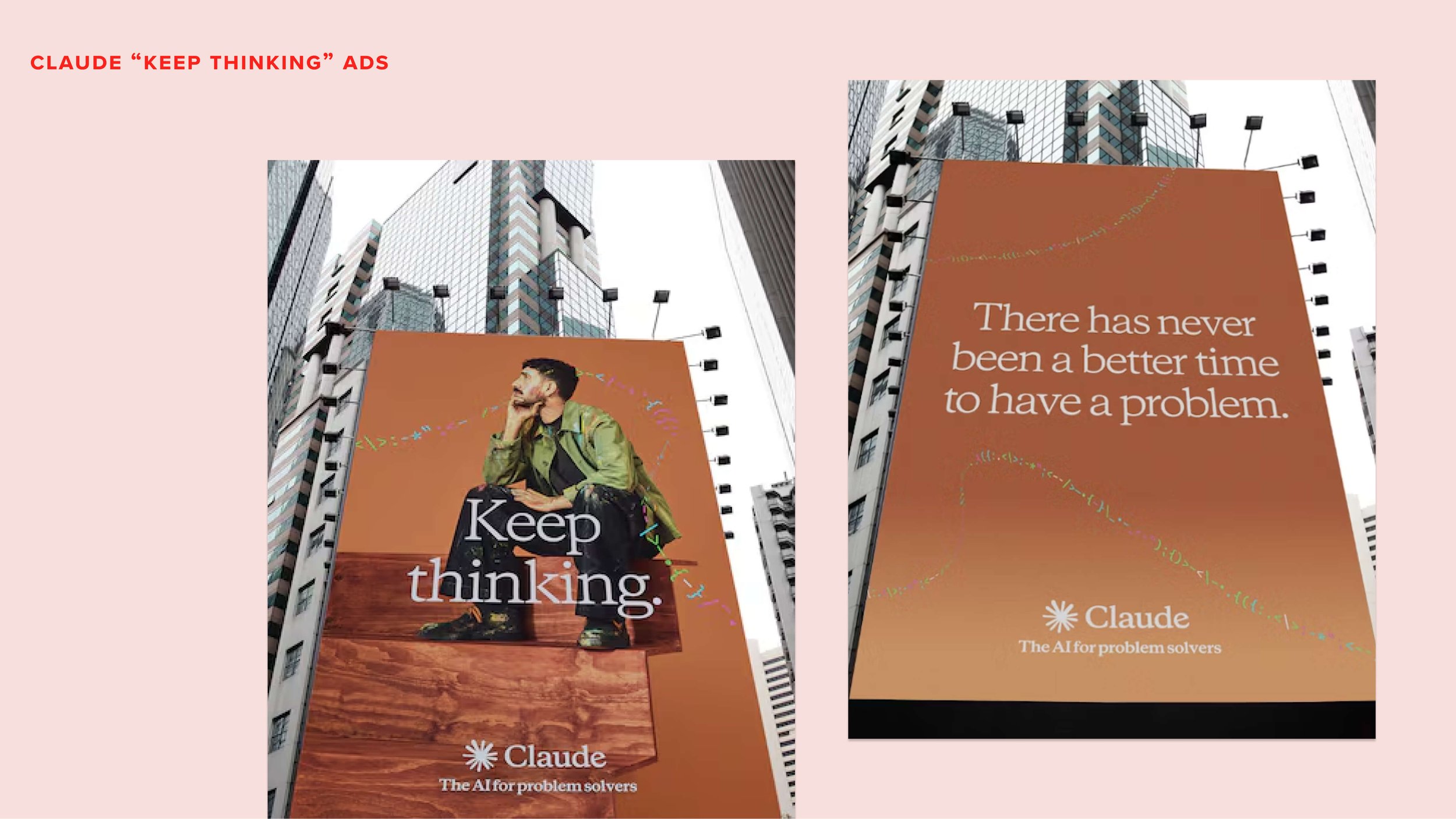
Claude/Anthropic campaign, named “Keep Thinking". The ads tried to shed light on a world that is increasingly AI-compliant.
In line with this mission, at the beginning of March, Claude appeared in the news. Anthropic had refused to sign two requests from the Department of War, because they were considered “outside the bounds of what today’s technology can safely and reliably do”, according to CEO Dario Amodei.
OpenAI stepped into the game and offered its full support to the US government. Anthropic decided to remove Claude from the process, while continuing “work to support the national security of the United States."
The US President, Donald Trump, commented on their refusal: “The Leftwing nut jobs at Anthropic have made a DISASTROUS MISTAKE".
Meanwhile, the news quickly spread, and within a few weeks Claude AI became the most downloaded app, dethroning ChatGPT. Claude even provided a step-by-step guide for those who wanted to make the switch.
We don’t know whether Dario Amodei will regret this decision in the future. Still, many people clearly felt that his brand was standing for their own personal values, remaining consistent with its promise. And that mattered.
While the company may have lost a major contract with the US government, the wider public rallied behind the decision, showing clear support for the position it had taken.
Refusing a big contract opened an opportunity: to remind the world of what Claude, and Anthropic, stand for. By doing so, the audience felt divided and compelled to take a conscious and ethical position – something I see as hugely positive, particularly when it comes to AI.
Something to learn:
Brands and products become political the moment they enter people’s everyday lives, because they have the power to change how we think, feel, and act. With this comes an ethical responsibility: to step up and honour the promises your brand has made to its audience, collaborators, and stakeholders.
Even when it might feel more convenient to walk away.
Last thoughts
The market is changing ever faster. I want this newsletter to be a reflection of why thinking only of challenges is like seeing the proverbial glass as half-empty.
Instead, thinking of opportunities that align with your brand’s values and promises can be a more creative way to shape narrative and perception in the mind of the user.
You might not agree with this point of view. But I’ve found that choosing to see the glass half-full makes me more creative — especially in a world where so many things feel like they are going wrong.