

#48. The Human Persona: designing for who they'll become
From the section “Summer Edition” of The Sunday Tales.
The Sunday Tales Summer Edition 2026 will explore topics from my upcoming book. As such, these newsletters will read differently, offering you a sneak peek into my way of working. I hope they will also inspire some healthy discussions!
Personas are supposed to make design work feel more human. Yet most of the time, they make our work feel more fictional.
A name. An age. A job title. A stock photo of someone smiling at the camera. A line about their "frustrations."
We've all built a persona like this: filled in the usual template, pinned it to a wall, and then forgot all about it once the product is created.
The problem isn't that personas are a bad idea. It's that most of them describe a one-dimensional character, who is doing something they already do with difficulty. Something that our product is supposed to improve.
All of this makes sense when your product already exists, but if you are designing something new for a startup or your own project, the person you're picturing hasn't met your product yet.
Their habits, their language, even their need, may be shaped by something that doesn't exist on the market. You can't research someone who hasn't become themselves, yet.
So what do you do instead?
Designing for someone who isn’t your user (yet)
I came up against this issue in 2021. Back then, I was in the midst of designing After App, an app for creating wills on the blockchain.
We had a general sense of who might use our app, but we did not have demographics, habits, or a tidy persona template waiting to be filled in. What we had was a list of features. It was far easier to describe what the product did than who, precisely, it was for.
At the time, I thought this was a limitation. It turned out to be the method.
Instead of forcing a target-group definition, which usually produces a pile of assumptions dressed up as research, I started from the features themselves. I then asked one question of each individual feature: What transformation do we want someone to feel after engaging with this?
Not what they'll do with it.
What they'll feel, or believe about themselves, as a result of using it.
That question, asked feature by feature, became a simple tool. I now call it the Bridge Matrix.
A sneak peek into The Bridge Matrix
The Bridge Matrix has two columns. On one side is listed the product features: concrete, visible, easy to define. The other side lists the emotional benefit each feature is designed to produce.
The Bridge Matrix follows two rules:
First: every emotional benefit has to be checked against your product’s purpose, which is the reason the work exists in the first place. If a feature doesn't produce a benefit that fits that purpose, one of two things is true: either the benefit needs rethinking, or that feature should not be part of the product.
Second (and this is the part that changes how the whole exercise feels): the emotional benefits are not assumptions. They are not hopes. They are intentional design targets. You are not guessing how someone might feel. You are deciding which feeling your work is responsible for creating.
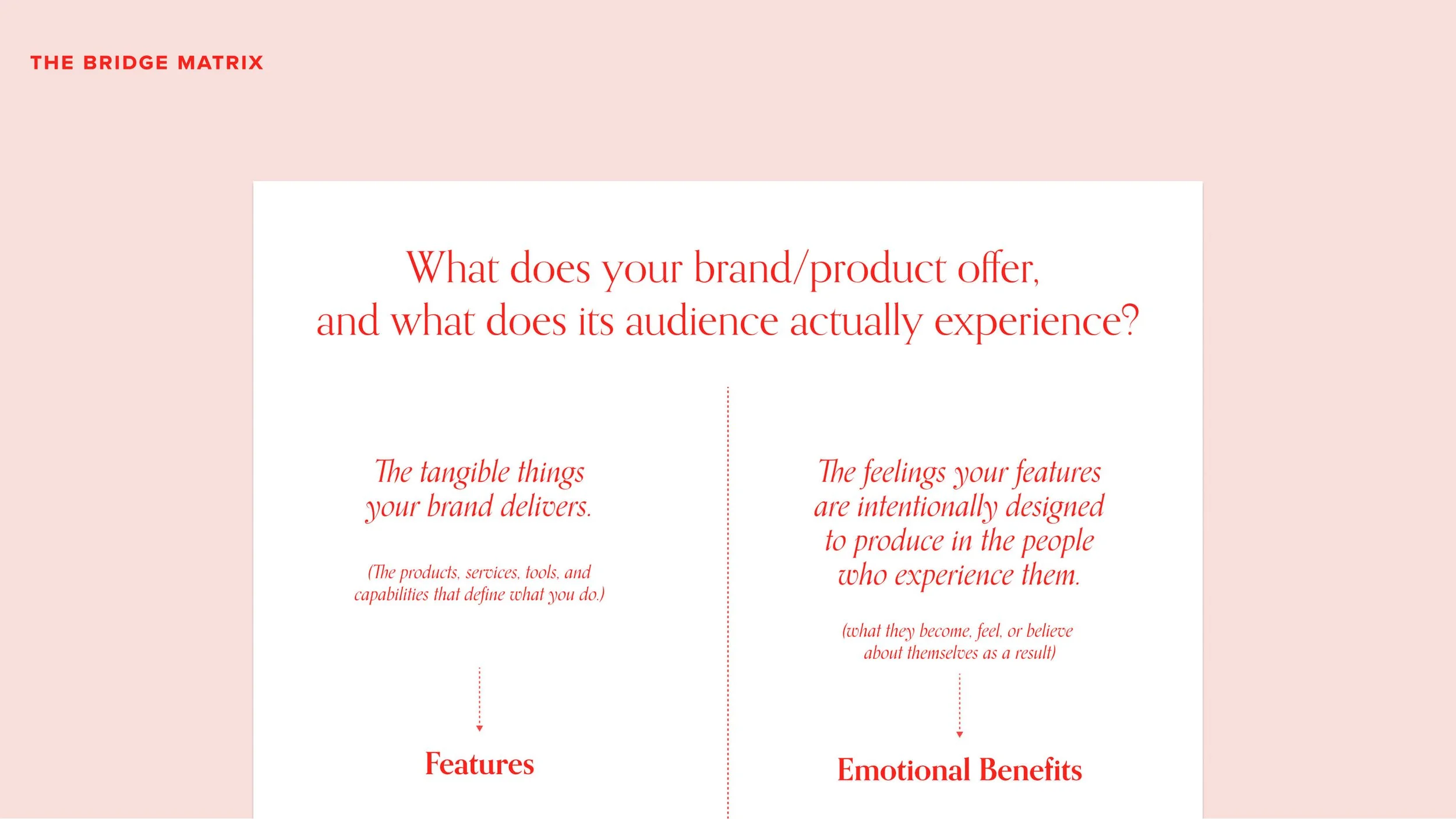
The Bridge Matrix. A simple scheme of the Bridge Matrix, just as I use it in my work as a brand designer and consultant across a variety of startups and projects.
You have probably surmised that this is a different kind of approach than the one most of us are used to. But persevere, because once the matrix is filled and tested against the product’s purpose, something useful happens. A person starts to emerge; one whose life and character go beyond mere demographics.
It is a human portrait crafted from the emotional territory you've just defined, rather than invented only to justify a product. I call this the Human Persona, and unlike the templated persona it holds up… because the Human Persona was never separate from the purpose to begin with.
The matrix and the person are accountable to each other, so if your product’s purpose doesn't speak directly to this person, something in the matrix needs revisiting.
I used this process to design the branding for Vitaly Friedman's course, Smart Interface Design Patterns (and the following courses). I looked at what other educators were doing, but the research that really mattered was narrower. What did Vitaly want to offer, and what feeling did we want someone to have by the time they reached the bottom of that page?
The features came first. The emotional benefit came immediately after. The page was a combination of the two.
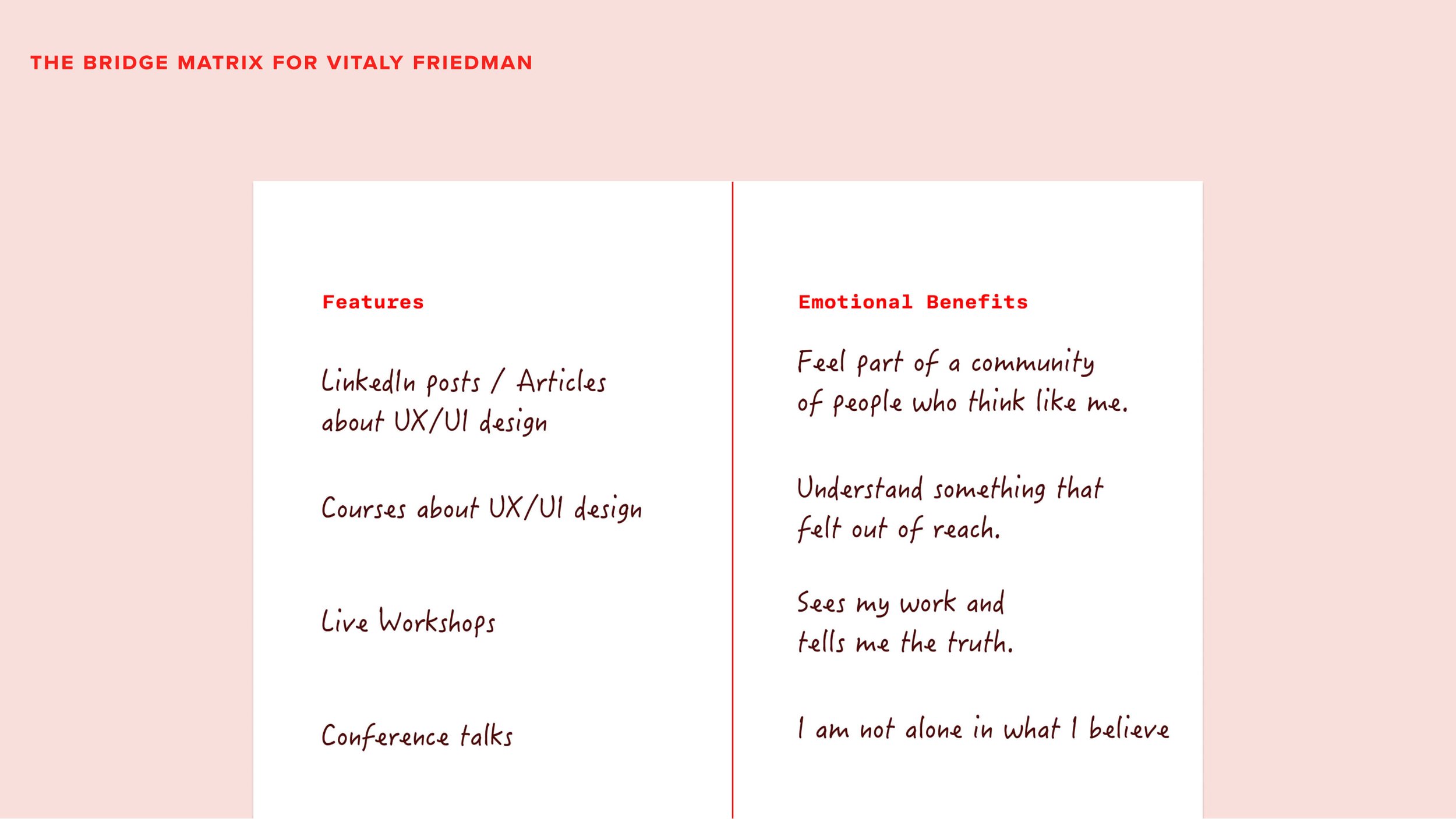
The Bridge Matrix for Vitaly Friedman. A simple representation of the Bridge Matrix for Vitaly's brand, before I designed the landing page of his first course.
Final thoughts
You may have noticed that this is a refrain from my previous newsletter, as well as a big theme of my book.
A goal is not a deliverable, but a future state.
A persona is not a demographic, but also a future state. It’s the place where someone arrives after meeting your work.
You don't need to know who your users are today. Your Human Persona embodies who they will become after they meet your brand and product.
That decision is yours to make and shape. Do both intentionally.
Do you want to learn how to design products and brands that meet their customers exactly where they are?
My upcoming brand strategy programme, Design Brands that Last, teaches you how to work with tools like the Bridge Matrix in an intuitive, natural flow. Chiara in the Room, an innovative Claude-powered skill built for the programme, helps you find the right Human Persona and position your brand in a genuinely human-centred approach.
Join today!
Ps. The subscribers of my newsletter receive an exclusive subscriber discount of 20%!