
#49. Why nothing in design is ever finished
From the section “Summer Edition” of The Sunday Tales.
The Sunday Tales Summer Edition 2026 will explore topics from my upcoming book. As such, these newsletters will read differently, offering you a sneak peek into my way of working. I hope they will also inspire some healthy discussions!
I have recently concluded another great collaboration with Vitaly Friedman. The project should be released very soon, but just for you, here is a preview-sketch of what I designed for him.
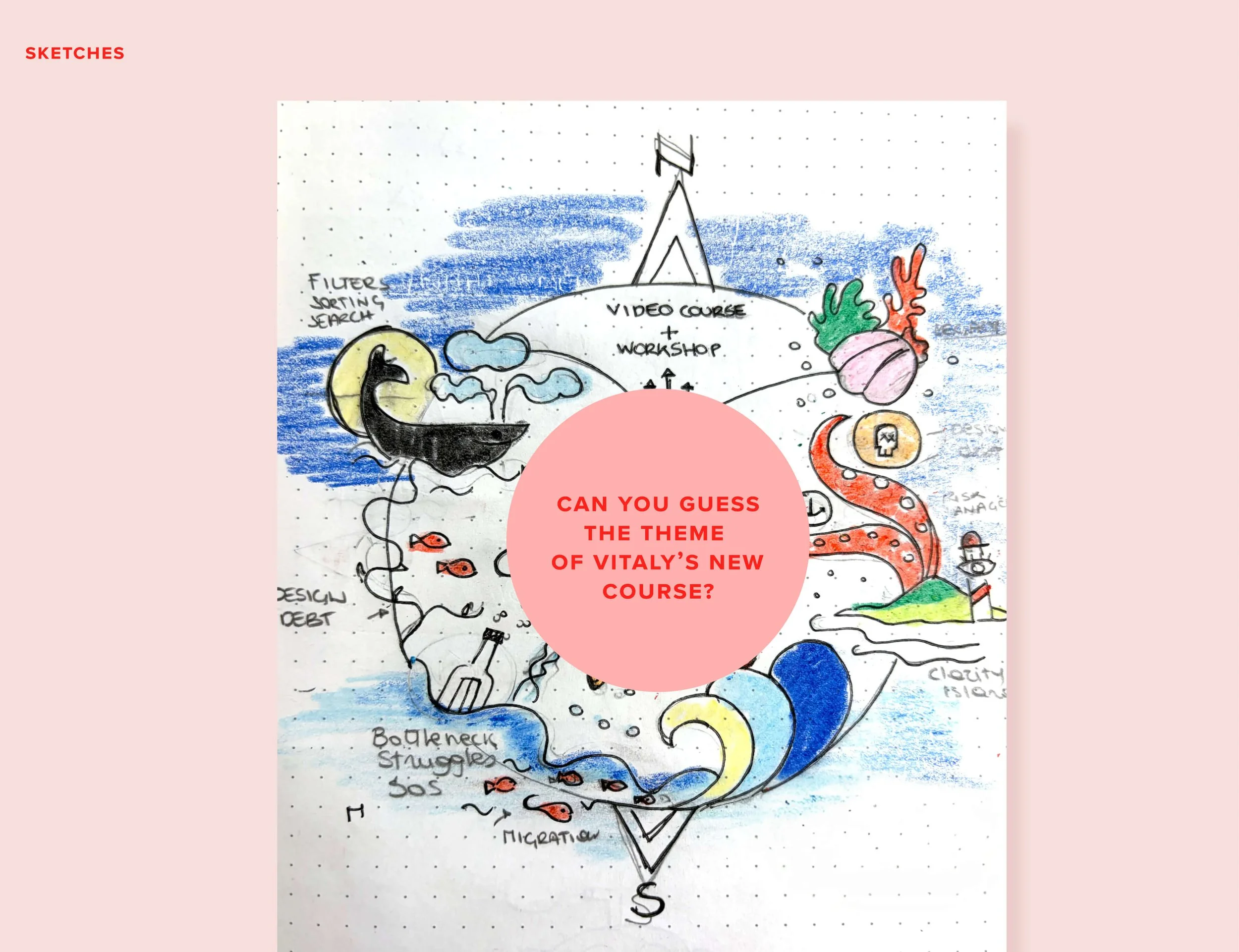
Sketches for the upcoming course of Vitaly Friedman. Can you guess the new theme and the inspiration?
When I conclude a design project, I feel a mixture of relief and satisfaction. While those feelings may be different for you, the ending of a project can inspire many of the same, instantly recognisable, words: Launched. Shipped. Delivered. Done.
The end is the finish line. The brief is closed, the invoice is submitted, everyone moves on to the next big thing. “Done” is the magic word that means a team can finally exhale.
I understand this scenario well, of course! But now I’d like to reflect on that specific word, “end", because when we work on future-focused products, design is never truly finished.
The story of Flipbook
A few months ago, I was talking with a founder about Flipbook; the experimental visual browser recently launched by a small team formed from OpenAI, Humane, and Apple employees. Flipbook uses AI to generate cards on demand, and the network to scale them. The interaction model is a stack of visual cards, on which you can click and expand.

Screenshot of Flipbook. An experimental visual browser recently launched by a small team formed from OpenAI, Humane, and Apple employees.
Flipbook is nothing new – especially if you are familiar with a previous project, called HyperCard.
Bill Atkinson built HyperCard for Apple in 1987. It was widely celebrated, used for over a decade, then quietly withdrawn from sale in 2004. Then, of course, technology moved forwards and the project was left behind.
Years later, Atkinson said: “I missed the mark with HyperCard. I grew up in a box-centric culture at Apple. If I'd grown up in a network-centric culture, like Sun, HyperCard might have been the first web browser."
As an idea, HyperCard wasn't wrong. It was just way ahead of its time. It sat dormant for nearly forty years until the network and the AI it needed finally existed, and then it came back: not as a revival, but as something genuinely new, built by people who weren't even trying to resurrect it.
What this little episode teaches us is that HyperCard wasn't over in 2004. It was merely waiting for its moment.
A small interruption…
You may think that reading the future may help...but actually, reading patterns and learning them could be more helpful in creating a future-proof product!
This is what I teach at Design Brands that Last, a live brand strategy programme for everyone who shapes brands and wants a methodology rigorous enough to drive and defend decisions.
Ps. The subscribers of my newsletter receive an exclusive subscriber discount of 20%!
The crucial, cyclical nature of design
The cyclical nature happens by design, in that the future you build towards in one cycle becomes the new present the moment you get there. And a new present always asks the same questions as the old one: what's actually here now, and what does it need? How will changes in people, technology and context impact my existing product, and what can be done about them?
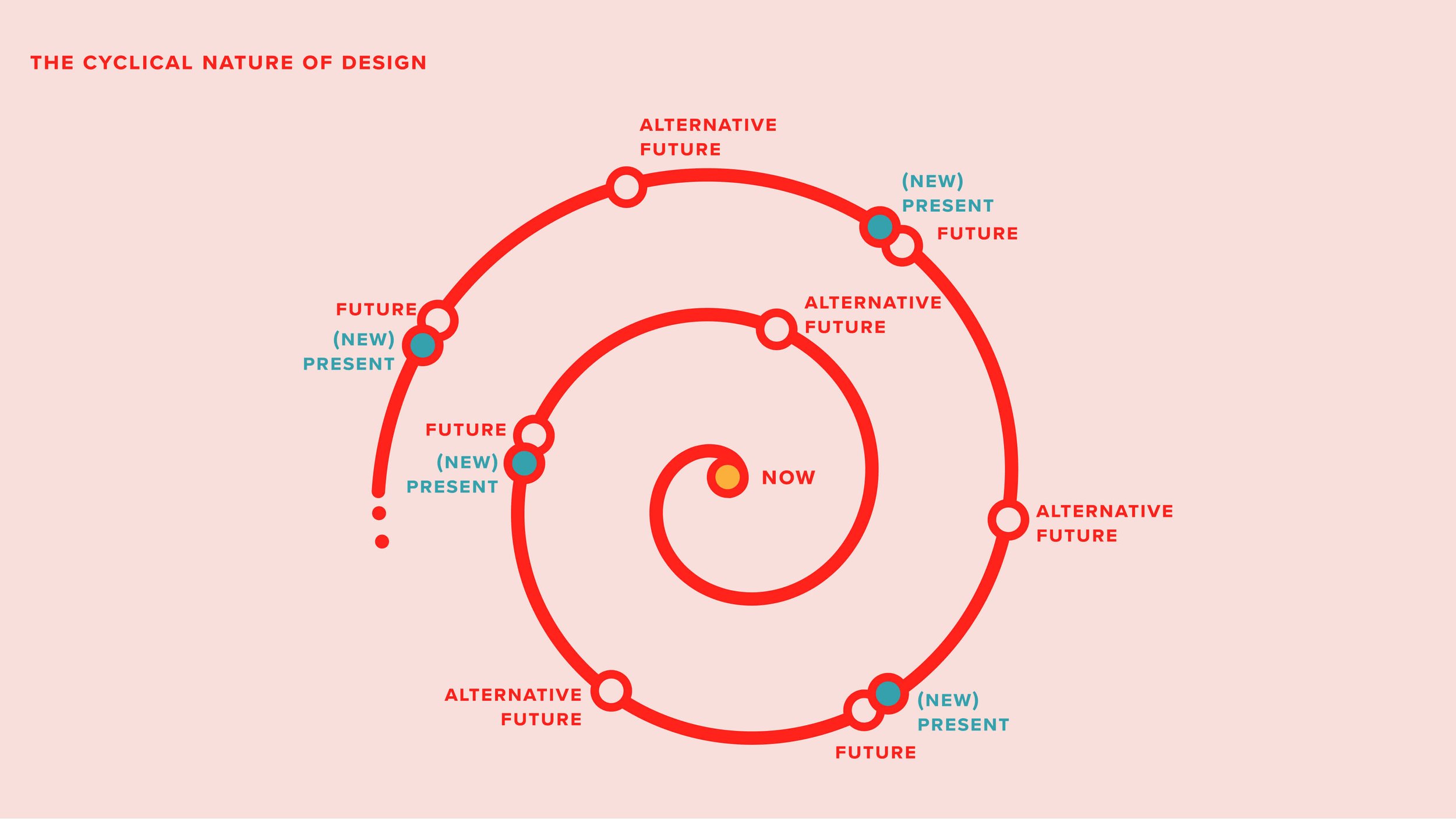
The cyclical nature of design. A simple scheme of what I mean by “cyclical”.
Cyclical design is not a flaw in the framework explained in my book and in this article. It simply treats the design process as living and ever-changing, rather than something delivered once.
Most of us designers were trained to think of the project lifecycle as a line (or perhaps a conveyor belt) on which is mapped a simple set of steps: brief, build, launch, done. I have used the same approach in relation to storytelling, in that a product, an experience, or a brand must have a beginning, a middle, and an end.
I have since realised that the project lifecycle is closer to a spiral.
You don't return to where you started, but to the same question from a greater vantage point. In this way, each “done" is really just the moment when one loop closes and the next one opens.
The danger isn't in the delivery
The real issue is when delivery of a project ends the designer’s obligation to keep observing. That’s how products and brands that fossilise at “done" are quietly overtaken.
HyperCard was overtaken not by a better idea, but by the same idea returning at the right moment, taken forwards by someone who was still watching.
The moral of the HyperCard’s story? Stop asking, “is this done?" Start asking, “in this new present we have created, what may benefit from being explored again?”
Of course, this is a harder question to live with. There's no satisfied exhalation at the end of it, for one thing (maybe just an invoice!) and no clean handover.
As designers, looking at the cyclical nature of our work is the only honest way to describe what happens after you bring something new into the world.