

#38. Does "Above the fold" work in the age of infinite scroll? Part 3: The Agatha Christie Strategy
In this last issue, we will focus on how to create suspense and mystery through scrolling. Note, however, that the Agatha Christie Strategy (as I call it, in honour of one of the most famous crime writers of all time!) can be the most difficult to apply.
When Agatha Christie weaves mystery and expectation into a story, she must engage her readers with the turning of every page. She must also ensure that the tale ends with a lingering sense of satisfaction.
Sure, some readers will rush to the last page (are you one of them?), but for most, the beauty of a mystery story is in its slow and steady – and deliberate – unravelling.

3 strategies to build lasting attention. They derive from my personal analysis of the cinematic world.
Finding a website that properly represents this feeling wasn't easy, especially when matching it with the Christopher Nolan masterpiece, The Prestige (as I write this, a new Nolan movie, The Odyssey, will be showing in cinemas soon!). Eventually, I chose a website that showcases a fine example of car design: the Porsche Cayenne. The website is aimed at a Spanish audience, but the logic behind it is universal.
Websites that present innovative products or ideas often use the Agatha Christie Strategy to build anticipation and reveal the idea step by step. In the early days, you may recall that Apple widely used this technique in its landing pages.
The Agatha Christie Strategy

Screenshots from the website, Porsche Cayenne Black. The website uses a cinematic, detail-driven scrolling experience to build anticipation.
Example: Porsche Cayenne Black Edition
The Porsche Cayenne Black Edition website uses a cinematic, detail-driven scrolling experience to build anticipation. Rather than focusing on specifications, it reveals the car gradually through curated imagery and selective information, guiding users towards a configuration platform where desire turns into personalisation.
Audience: Porsche enthusiasts and collectors. A high-end, predominantly male audience with strong brand awareness and high sensitivity to detail, rarity, and status.
Purpose: To persuade. Rather than blatantly selling, the website introduces this car model through carefully curated details, guiding users towards the configuration and e-commerce experience only when their curiosity is piqued.
Resolution: Achieve a Status: Owning this Porsche represents the achievement of a specific status. The website reinforces that by isolating and magnifying the elements that make the model distinctive and difficult to compare. By withholding full context and focusing on selected details, the car becomes less a product and more a collectible object: something to be deciphered, desired, and ultimately possessed
By first analysing The Prestige, it quickly becomes clear that balance is key.
A high level of mystery must be supported by an elegant narrative, conveyed through sequence, images, words, and actions, and by a seamless scrolling flow.
Note that too much mystery can leave the user wondering if they’ve missed something, if there isn’t a final resolution that brings all these elements together.
In The Prestige, the three-act structure is interwoven with three temporal layers that constantly mirror and disrupt one another. These three temporal strands are not presented linearly.
During my research, I also found a website presenting a Dream Recorder. I found the idea extremely interesting and innovative, especially for its open-source approach and self-assembled hardware. Yet I couldn’t understand how to use the GitHub page, or even how to obtain the product. (If you manage to solve this mystery, please let me know!).
What this shows is that balance really does matter. If you scatter clues throughout your story plot (whether in a film, a website, or a digital experience) without bringing them together or offering a clear explanation, the result is not intrigue. It’s confusion.
The Prestige’s three-act structure shows how these details are introduced sparsely throughout the plot. I’ve included small hints that will make you want to watch the movie (or watch it back again), just to see how they work!
(For those who want to avoid spoilers, don’t worry! I have added a helpful star to the parts where I give the game away).
Act 1: The Setup / The Pledge
The Prestige begins with one sentence, written in the dark: “Are you watching closely?”
The first scene shows the mechanics of a magic act, and how it creates the desired audience effect. Meanwhile, the scene’s narrator explains that a magic performance consists of three parts: the pledge, the turn, and the prestige.
The story starts at the end (similar to the Teaser Strategy, except that this ending says nothing about the main characters, so don't be fooled!).
We are soon presented with two magicians’ pasts, and how an accident ultimately defined their destinies. The narrative then unfolds by revealing details about their individual personal lives.
In the same style, the Porsche Cayenne website opens with a video showing the car in motion, with small visible details (like the name on the car). This is not a trailer. It does not tell us anything useful about the car. Yet it is carefully thought out to heighten suspense: not much more is revealed even when scrolling down.
The accompanying image shows the car from behind, in perspective. A brief description highlights an individual characteristic. Here, neither the image or the text will make you buy the car, but it will definitely make you scroll. (If it were an Agatha Christie book, you’d feel compelled to turn the page!).
Back to The Prestige, and we now know that not everything is as it seems. The movie gives us so many details that we have to collect them up, like an investigator, and try to make sense of them. This is the strongest part of the Agatha Christie Strategy, and it’s also the trickiest to pull off.
Some scenes, like the Chinese magician scene, also feel strangely unrelated, until we reach the end of the movie. Translating this back to the website, we know that we won't understand much more about the Porsche Cayenne through scrolling. We’ll only see close-up interior images that can't even be enlarged.
The setup. Video and details create anticipation. Just enough to keep you scrolling.
Act 2: The Confrontation / The Turn
After The Prestige’s long first act, an accident happens, and the lives of our two magicians change course. One seeks revenge, while the other seeks to balance life between love and duty.
We get to know these two characters and their internal struggles intimately.
The plot moves along at pace, so much so that suddenly, we’re at the halfway point of the movie! Yet we still don't know what really happened.
New characters appear: Falan, the mute assistant, a charming Nikola Tesla (interpreted by my favourite musician, David Bowie); a sosia; and a new lover-assistant (interpreted by the actor Scarlett Johansson).
In the same way, the Porsche Cayenne website starts to reveal more of the car. Now the exteriors are presented, with enlarged images and a carousel to help the user navigate more quickly. There are hints, all of which offer elements of the product, but they are not yet joined together.
The confrontation. The carousel helps users uncover additional details of the car, speeding up navigation while maintaining the sense of discovery.
Act 3: The Resolution / The Prestige
In the final part of The Prestige, the pieces are finally put into place. But not immediately!
We are kept in suspense until the film’s epilogue, when the two characters confront each other and reveal their tricks. Only then does the meaning of the story become clear, in a moment that is The Prestige itself.
(Remember that opening question: “Are you watching closely?” You’ll find the answer here!).
Similarly, the Porsche Cayenne website invites users to take a closer look at the car by guiding them towards personalisation. Rather than explaining everything up front, it encourages them to define their own model, through dedicated configuration on an affiliated platform.
The website’s final section reinforces this idea of “looking closer”. It presents more images and a video of the car (note that the images are the same ones we saw earlier, arranged in a different layout). But at this point, they carry a different meaning: after exploring the configuration, the user now understands the value behind each detail. Until a Porsche is configured to its smallest elements, it remains just another car. Once personalised, it becomes their car.
IMPORTANT: If you want to sell a product in this way, you must use the Agatha Christie Strategy on a page that has a resolution to persuade. Otherwise, you risk using too much mystery without payoff. This won’t create intrigue, but doubt. In other words, this strategy won't do the selling for you.
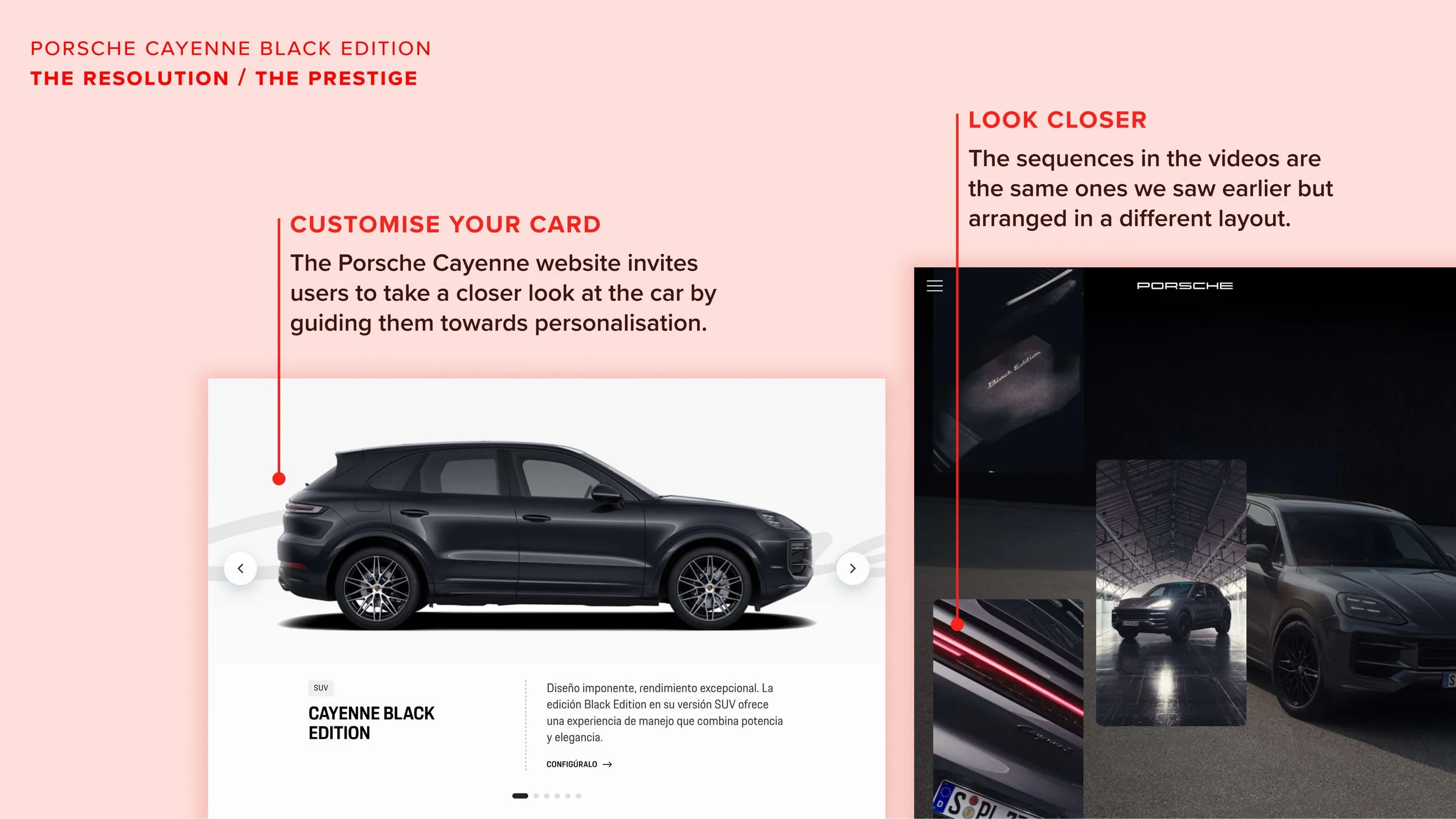
The Resolution. At this point, the pieces fall into place: the car is fully personalisable, and every detail shown can be tailored to the user’s taste.
As a quick reminder, when using the Agatha Christie Strategy:
Don’t do this:
Reveal everything too early or too clearly
Confuse mystery with a lack of information
Scatter details without a final moment of resolution
Ask users to make decisions before you’ve fired their curiosity
Assume users will “figure it out” without guidance
Let the experience end without tying all the clues together
Do this instead:
Introduce information gradually, through carefully-chosen details
Design scrolling as an act of investigation, not consumption
Let users feel they are discovering the detail, rather than being told
Maintain an elegant narrative flow through visuals, copy, and pacing
Ensure there is a clear moment where everything comes together
Reward attention with understanding, clarity, and meaning
The Agatha Christie Strategy works best for:
The audience is already knowledgeable and emotionally invested
The product carries status, rarity, or exclusivity
Desire is built through detail and atmosphere, not comparison
The experience aims to elevate the product into an object of aspiration
The final action (purchase, configuration, membership, access) feels like a reveal rather than a transaction
Luxury brands, collector items, limited editions, cultural projects, and high-end launches
Contexts where anticipation increases perceived value.
I reserved this strategy for the last part of our “Above the fold” series because I think it requires a good understanding of the elements of storytelling, such as withholding, sequencing, and revelation. It also asks more of the user, rewarding them with meaning, status, and satisfaction if handled with care.