

#45. Michael, the movie. The strategic role of storytelling in brand experience.
On Monday, I went with some friends to watch the Michael biopic, and here I am with some thoughts, not entirely uninfluenced by my recent workshop, Design Brands that Last, where brand experience is exactly what we pull apart in Week 3.
The movie was two and a half hours of songs I already knew, moments I half-remembered. I walked out with a feeling I could not quite name. Probably nostalgia.
The film is not trying to tell you the full truth about Michael Jackson (whatever that is). It is trying to remind you of the version you already love, and quietly expand the space around it for what comes next.
When I got home, I sketched the 3 act structure of the movie, as you see it below, to understand how the movie used storytelling strategically in each act.
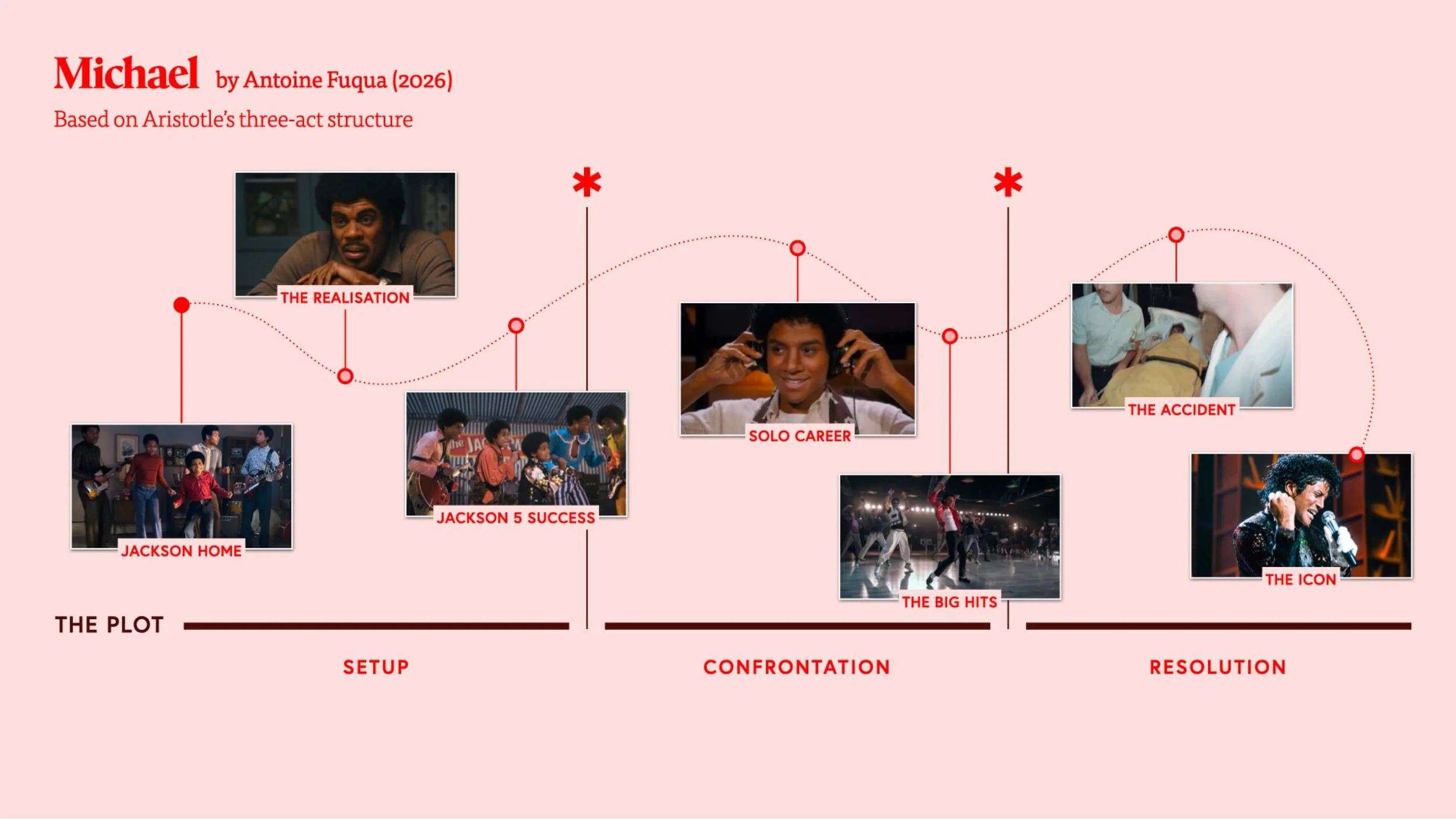
Michael, the movie. The 3-act structure of the movie.
Somewhere between the Jackson 5 scenes and the first notes of Thriller, I realised I was watching a piece of brand strategy as much as a film. Want to go on a (moon)walk with me and analyse the 3 acts of the movie and each storytelling strategy?
Let's start!
ACT 1: Acknowledging the wound just enough to move on
Act 1 is the point in the film that made me uncomfortable, which probably means it is the most interesting one.
Michael's childhood, including the abuse he suffered and later spoke about himself, is present in the biopic. But it is handled with a specific purpose: to explain what comes next in Act 2 and Act 3.
His attachment to Peter Pan, his relationship with animals, his resistance to growing up, and the fear of his father are treated in the film not as questions to be examined, but as the natural result of a wound the audience already knows about.
The difficult truth surfaces just enough to make what follows feel inevitable. The film acknowledged it. It did not dwell. Then the story moves forward.
The wound becomes the explanation for everything the audience is about to accept.
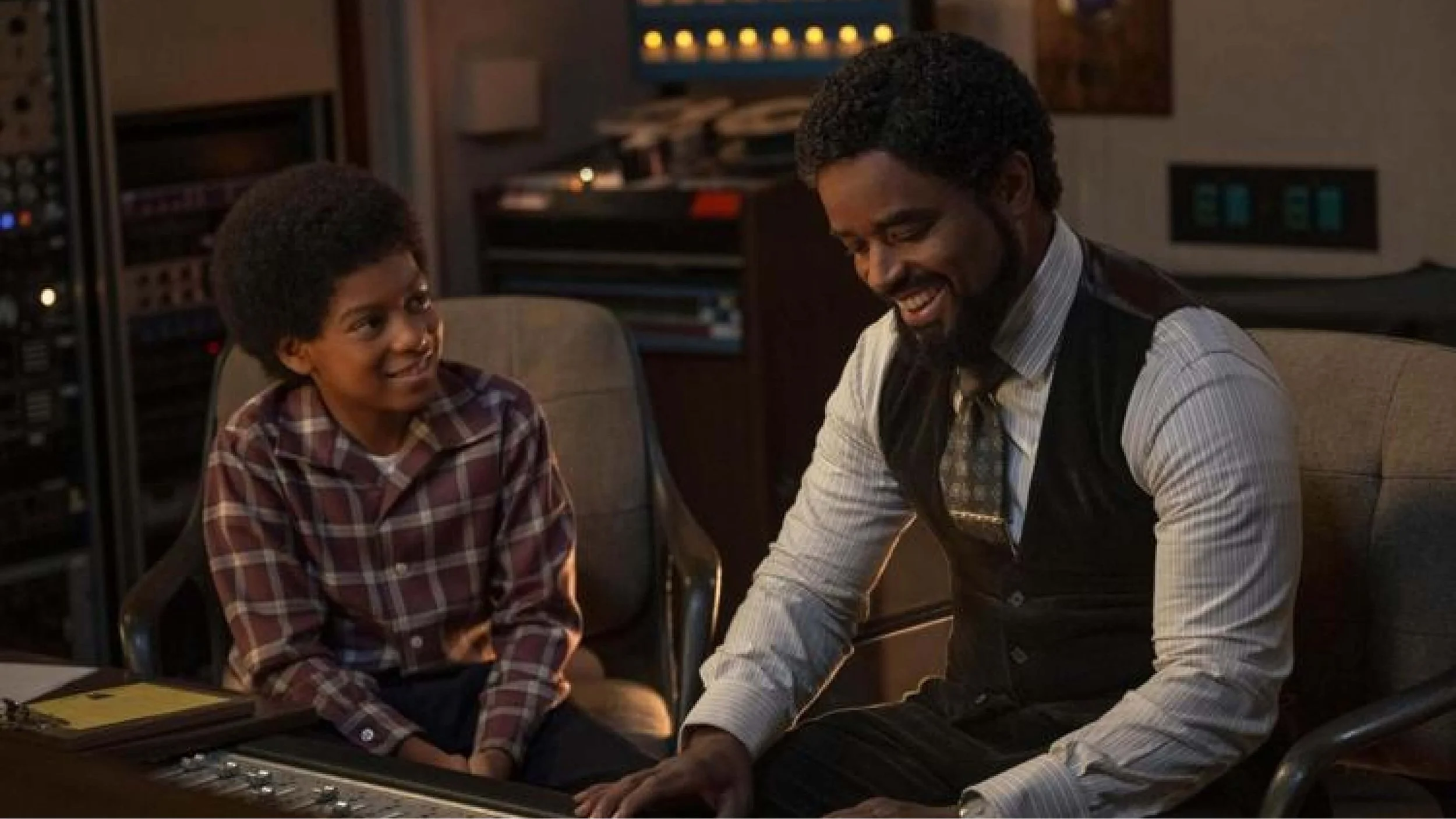
Michael, the movie. Young Michael Jackson sitting at a recording studio console with producer Berry Gordy. One of the moments the biopic chooses to linger on…for a reason.
What does this mean for those of us who design brand experiences?
For years, Adobe built a narrative around community and creativity, and used it to make a structural constraint feel like a commitment you had chosen freely. I recently tried to cancel my Adobe subscription and found I could not do so without paying for the remaining months.

Adobe Subscription Model. The moment the story of creativity meets the reality of the contract. Cancelling an Adobe subscription costs more than staying.
I traced it back to when Adobe began restricting what users could own: the move from perpetual licences to Creative Cloud subscriptions.
The emotional story used to promote this transformation was real: always connected, always growing, creative tools available to everyone. What was harder to see, in the middle of that story, was that designers were losing the ability to own the tools they had built their careers on. The acknowledgement of disruption was woven into the excitement of progress.
The pattern is not unique to Adobe. Think of any subscription price increase announced alongside a generous list of new features. The story of value is there to absorb the story of cost.
ACT 2: Refreshing the memory of an audience
Act 2 opens with the biopic crystallising the moment Michael stops being a child in a group and becomes an icon on his own. The songs arrive exactly when you need them. The choreography is precise. The film knows which moments to linger on and which to compress.

Michael, the movie. The icon separates from the group, but not yet from the family. The studio is where Michael begins to understand the difference.
I was at a party recently when the hosts took pictures of each of us and gifted everyone a photo. It was a Polaroid.
For years the brand has been building its experience around a specific message: the analogue quality of life. The 2025 campaign "The Camera for an Analog Life", launched alongside their new Polaroid Flip camera, was built around “a bold statement in a smartphone-saturated world with a disruptive creative designed to make people stop, reflect, and put down their phones."

"The Camera for an Analog Life." Polaroid's 2025 campaign does not sell a camera. It sells the one thing a screen cannot give you back.
But let's talk about the whole product experience: the camera is not objectively good; the film is expensive; the physical size is clunky.
And yet Polaroid keeps returning to its one irreplaceable truth: the photograph that appears in your hands. The real moment no screen time can replace. That moment is tangible, imperfect, but most of all, yours.
It is what the brand anchors everything on: not the product, but the experience of holding something real.
Selective memory is not dishonesty. It is an editorial choice.
The question is whether the choice serves the audience or the brand alone.
ACT 3: Managing emotion to preserve what comes next
Act 3 builds toward a climax involving an accident I will not spoil here, and then opens into vast concert sequences. Full scenes, lights, crowds, sounds that fill the room. (I nearly stood up to dance, and only stopped myself because I knew I would annoy the people behind me.)
I do not think the plot required all of it. I think the film needed to produce a specific feeling in the body of its audience: a physical memory of being inside something enormous, and it needed that feeling to carry beyond the cinema.
The concerts are not a celebration of the past. They are a deposit on the future (there are already rumours of a sequel!).
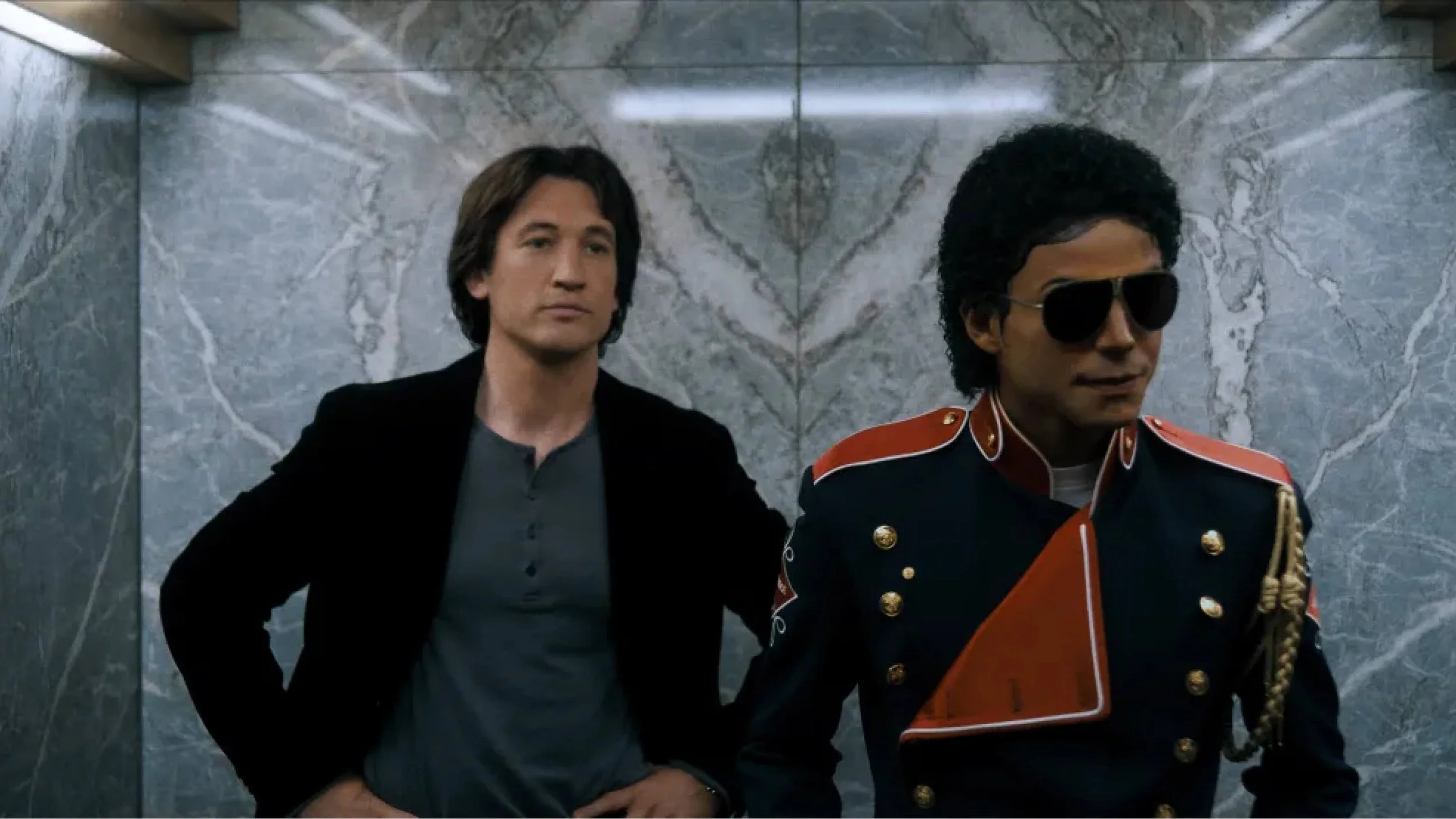
Michael, the movie. Decisions that define a legacy are rarely made on stage. This elevator, this conversation with lawyer John Branca, is where the King of Pop is sealed.
Brands do this too. The sequel they are building is rarely announced in advance.
Airbnb has done exactly this. The attachment people feel to the brand is not really about accommodation. It is about belonging somewhere unfamiliar and finding the local version of a place rather than the tourist one.

“Now you can Airbnb more than an Airbnb." The 2025 Summer Release is not a product update. It is the moment emotional equity becomes a business extension.
That emotion is what Airbnb used to rewrite its own brief. In May 2025, with what they called their Summer Release, they launched Airbnb Services and Airbnb Experiences under a single statement from CEO Brian Chesky: “Now you can Airbnb more than an Airbnb." Chefs, massage therapists, personal trainers, local guides, all bookable inside the same app people already trusted with their front door keys.
The most important detail of the experience: you do not even need to book a home to use them. The equity was emotional before it was functional. And that emotion made room for everything that followed.
What this leaves me thinking...
Michael is a film that knows exactly what it is doing. It is not a documentary. It is not an apology. It plays a strategic role in clarifying what to remember, framing what was difficult, and building anticipation for what comes next.
Whether that is admirable or uncomfortable probably depends on how close you are to the subject. But when I see the same three patterns in brands: the selective memory, the contextualised wound, the emotional deposit made against a future extension, I find myself asking: what is this story protecting? And what is it preparing us for?