
This week my client Kristina Podnar announced her new book, The Power of Agentic AI Policy, out on 19 January.
We designed her first book, The Power of Digital Policy, together eight years ago, so I treated this cover as a sequel. The first was inspired by the idea of a garden with fences. This one sees Kristina more like an early scout exploring a forest.
The process followed my usual way of starting any concept: by hand.
After the presentation of the cover, I sent Kristina the sketches, to show her how it came together, and for fun I wrote: “No AI was used for the creation of this cover."
She happily replied: “We should write that claim in the book."
It turns out that some of the biggest brands in the world are making a very similar claim this Christmas.
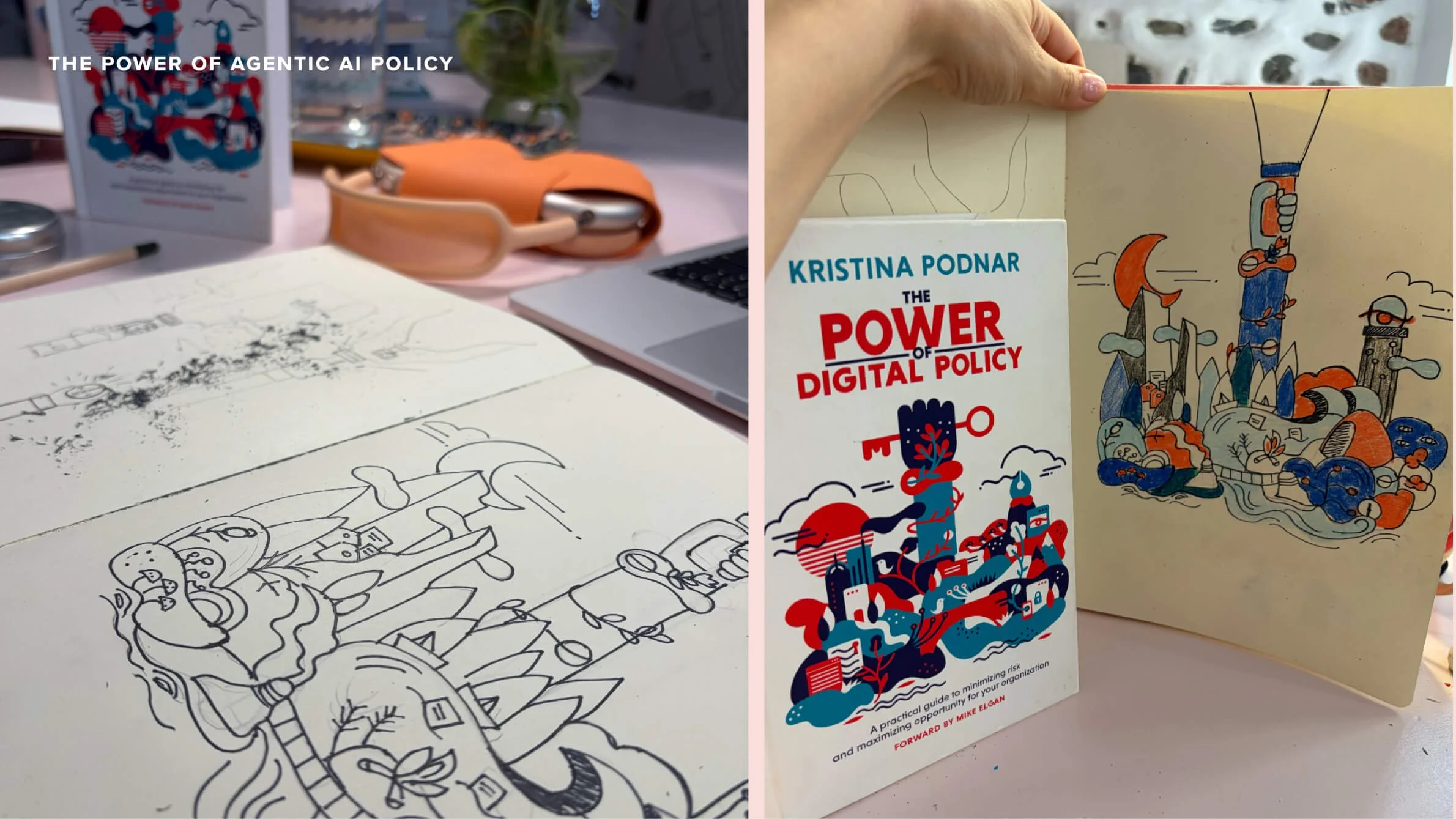
The Power of Agentic AI Policy. The making of the cover, with my sketches and the first book in sight.
Human made is a choice based on values, not trends
This Christmas, human-made ads have become a must among luxury brands (Fast Company gathered a few of them).
I read two messages in it: “we can afford a real person to design our ads", and a refusal of the uniform look that AI-made work tends to share. Neither is a campaign against AI.
The tendency started in June, when the Spanish house Loewe celebrated its 180th anniversary with a beautiful animated film painted by hand. I wrote about it in my issue on Christopher Nolan's The Odyssey, and luxury brands seem to be carrying on in the same direction.
Prada has launched its Christmas campaign, Drawing Prada, and its world reminded me of the old Disney films (Snow White, or Cinderella). There is a reason for that. The animation was drawn by hand under John Pomeroy, a former Disney animator who worked on Pocahontas and Fantasia 2000. Prada also documented the process, to show how the ads came together.
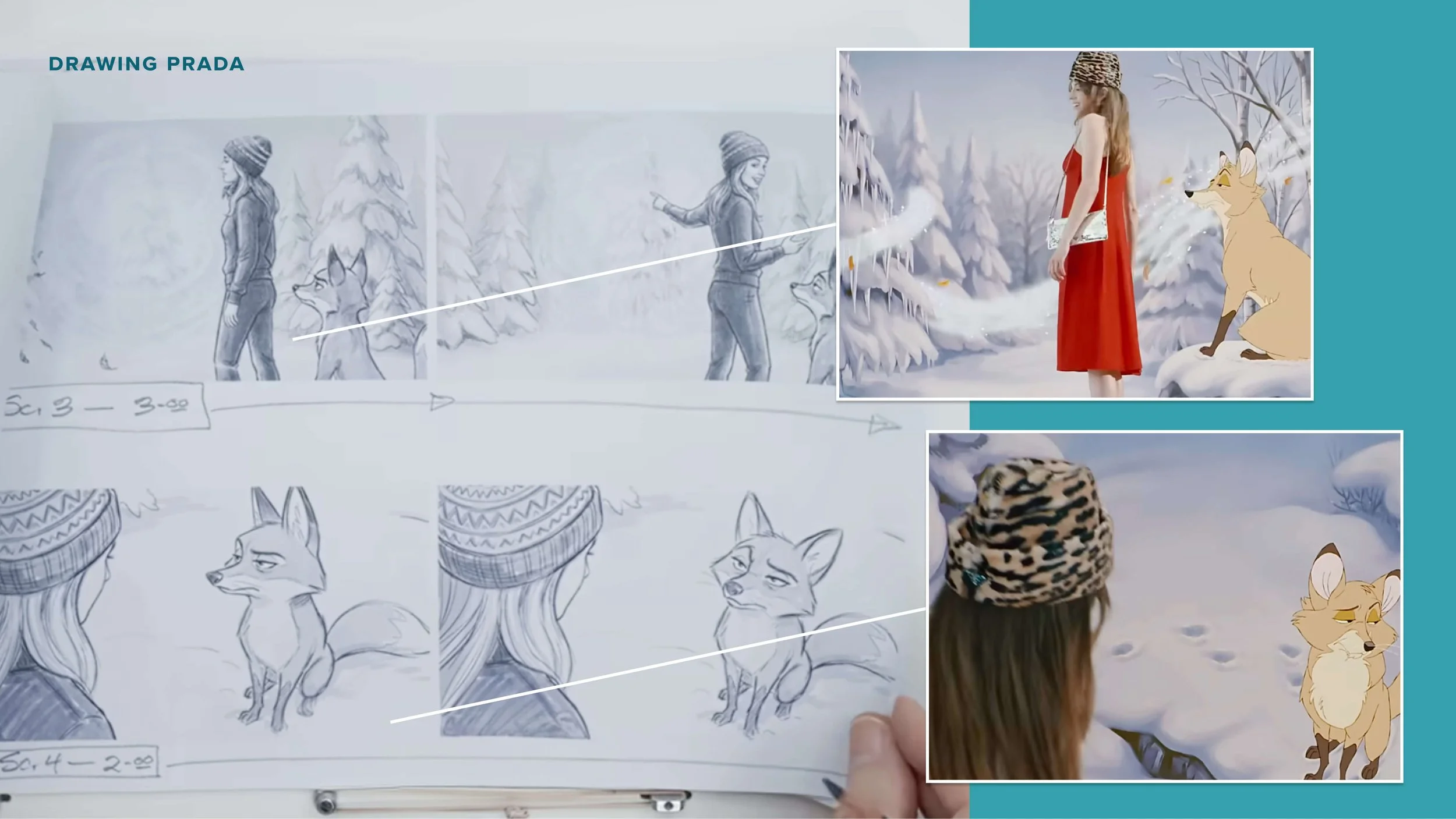
Prada. Drawing Prada, this year’s Christmas campaign, animated by hand under John Pomeroy.
It makes sense. For brands like Loewe or Prada, a campaign made by hand fits their values of craftsmanship and attention to detail.
AI design does not really fit either, so choosing real people who sketch and draw stays in line with what the brand stands for.
Technology is still a must
None of this is a rejection of technology or AI itself. As I explained in that same issue on The Odyssey by Christopher Nolan, it is how we balance technology inside the design process that helps anyone achieve amazing results.
For its Wimbledon campaign this summer, Ralph Lauren used CGI to bring its teddy bear mascot to life next to a charming Tom Hiddleston, and the Instagram caption says so openly: “live-action footage and CGI technology".
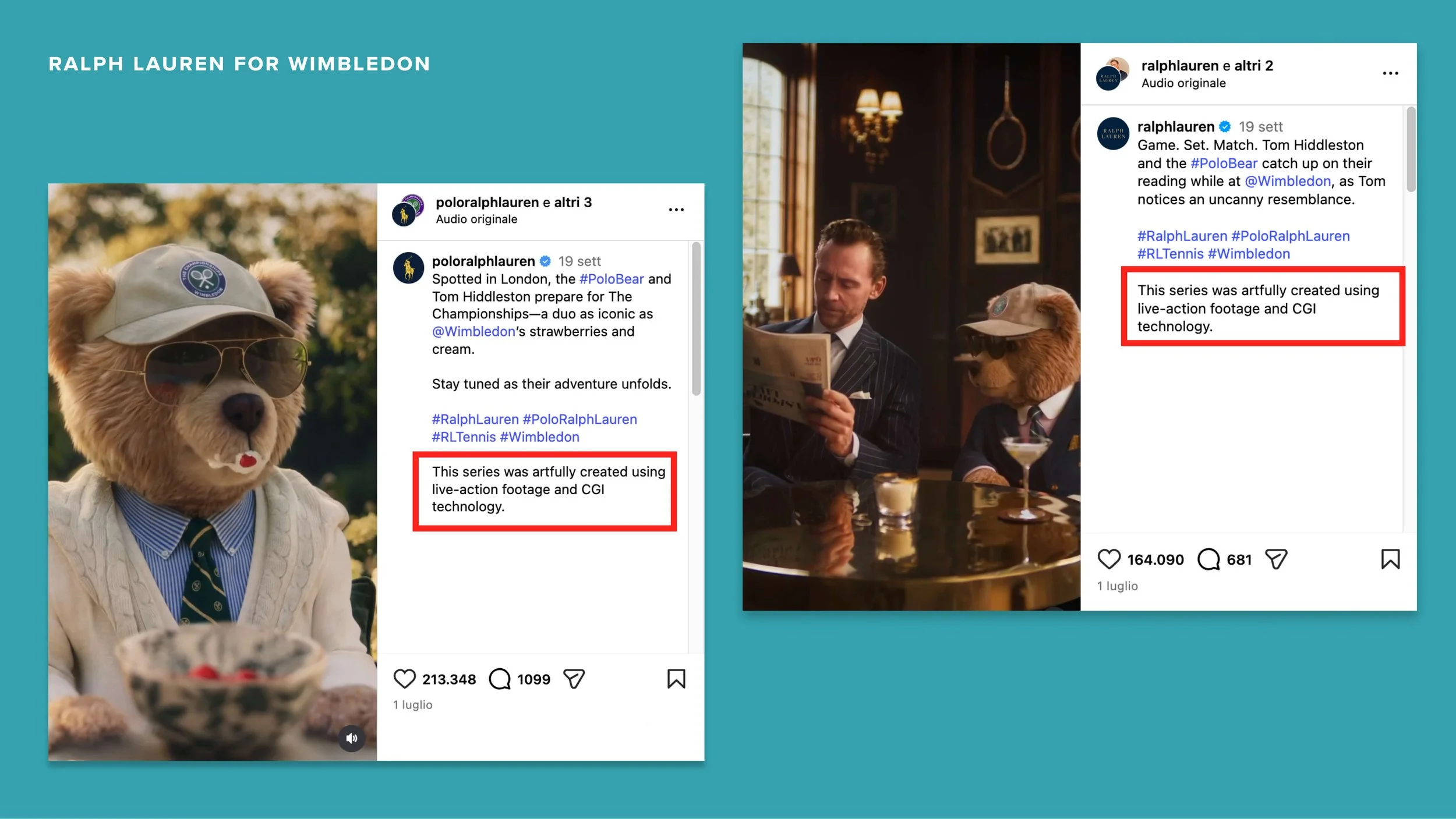
Ralph Lauren. Tom Hiddleston and the Polo Bear at Wimbledon. One of them is CGI, and the caption says so.
Technology, together with the creativity of the human mind, can bring incredible ideas to life. That is what these ads are celebrating this year.
Look at Grand Theft Auto VI, due out this Thursday (any fan among my Sunday readers?). It is a tech product that needs enormous computing power to meet what its players expect, and its publisher runs hundreds of AI pilots to save time and cost.
Yet the same publisher says that generative AI has “zero part" in what Rockstar is building, because the handcrafted worlds are what set the game apart.
AI does the work where it is effective, and people create what makes the product unique to its audience.
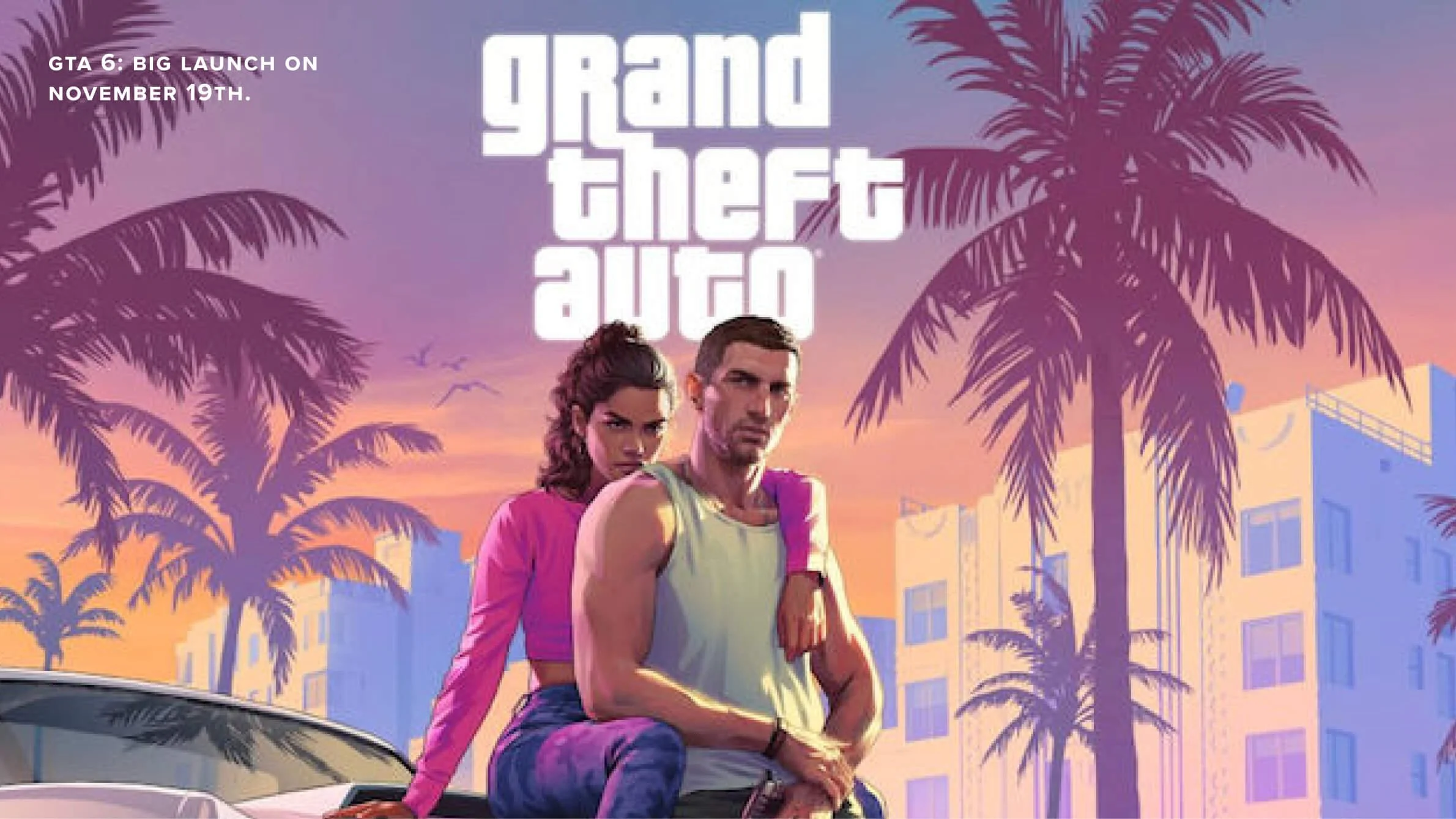
GTA VI: Grand Theft Auto VI, out on 19 November. A world built by hand, says its publisher.
What is in it for designers
In my workshop, Design Brands that Last, we talk a lot about balancing AI inside the creative process, and even about stating how you use it on your website and in your contracts.
Kristina's cover is a good example, because my claim to her is true only for the idea, the drawing and the final execution.
AI came in during the brainstorming. I shared my idea and asked it to check some sources and stories I was inspired by. In fact, the cover draws on Dante and his journey through the three realms, and I wanted to check quickly that my reference was accurate.
Then I drew the cover by hand, keeping the first book close so that I could take its elements and reinterpret them under the new metaphor of the forest, and I built the final design in Illustrator.
Once it was done, I asked AI to check the spelling and the contrast between the colours. Finally, I briefed AI with all the thinking behind the process and condensed everything into a few slides for the presentation.
Throughout, AI followed the three Ds of robotics: gathering information and verifying it against my own knowledge (Dull), checking spelling and contrast before the cover goes to print (Dangerous), then cleaning up and organising my own thoughts into a presentation (Dirty).
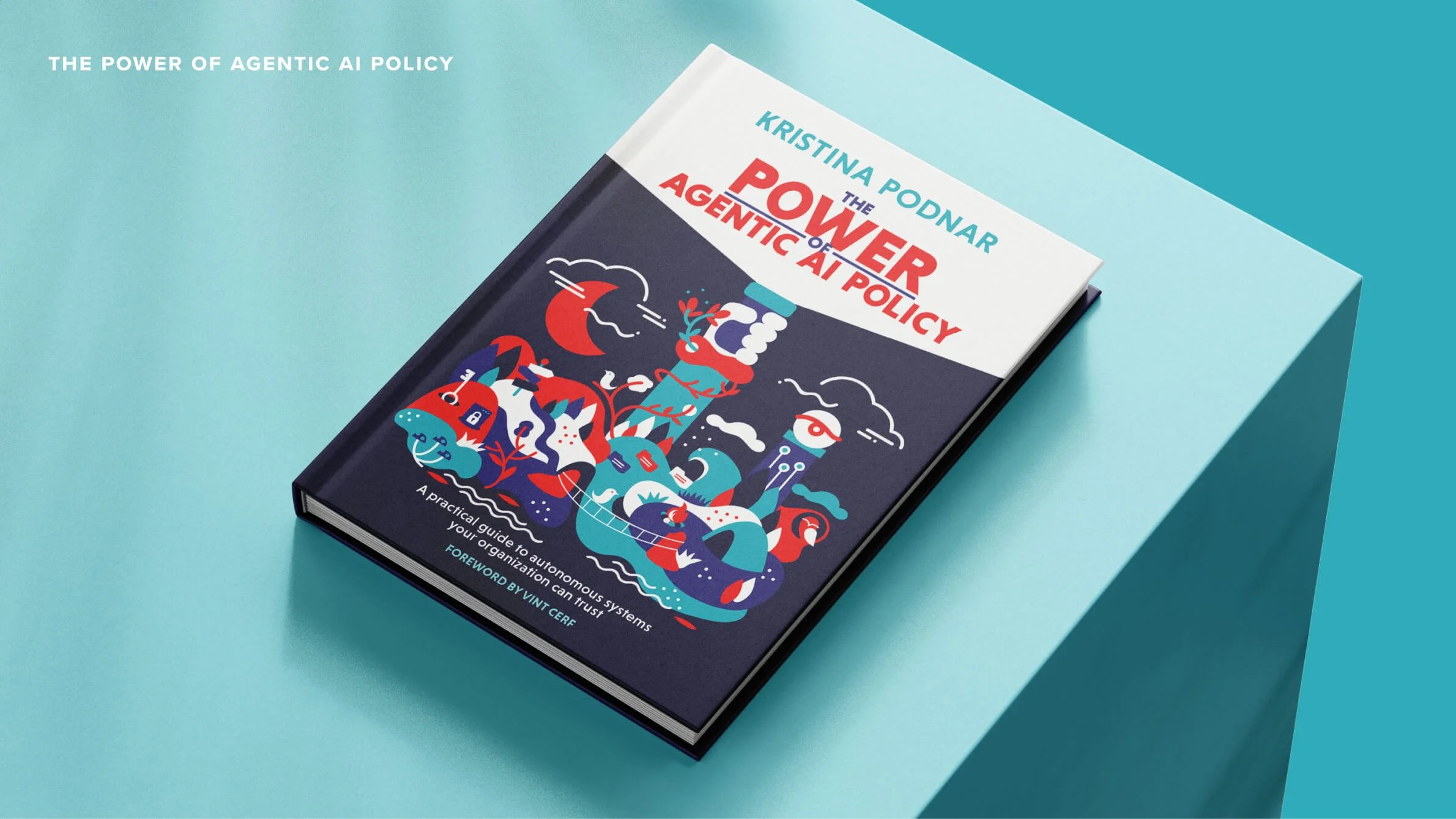
The Power of Agentic AI Policy. The book is coming out on January 19th.
At no point did AI do the designing, or anything I enjoy doing myself. Because my brand values are about storytelling and human connection.
In the same way, I encourage you to use AI according to what fits the brand's values.
If the brand talks about human connection and authenticity, making its campaigns with AI is probably not the right call, and AI should be confined to the more peripheral decisions of the design process. If its values are about innovation, being future-proof or anything else that invites the technology in, AI can take a more active part.
I still think the ideas, and whatever makes the product unique, should come from humans. In this scheme, I show you how I see AI integrated in the creative process according to brand values.
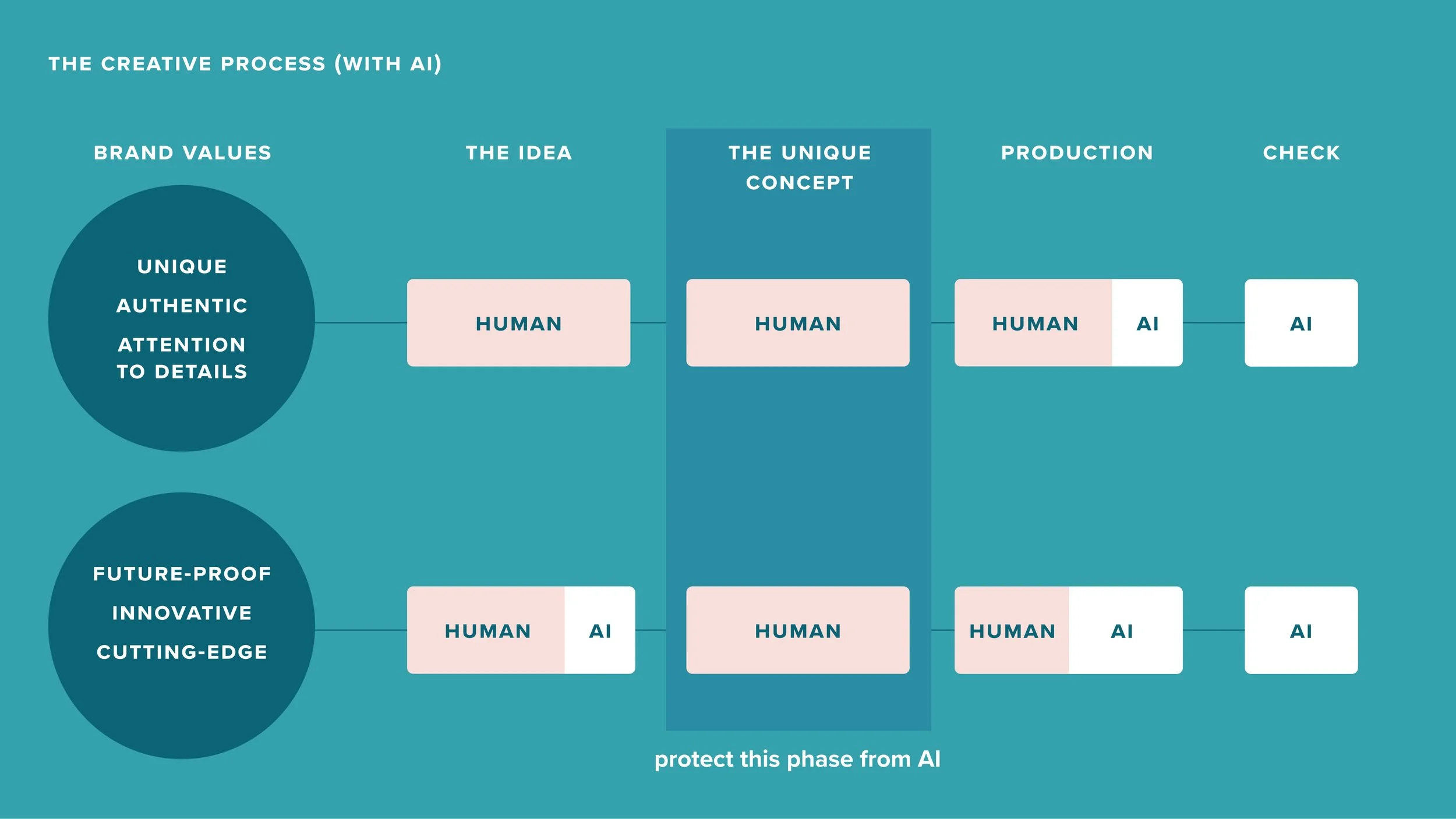
The creative process. The same steps, with different values deciding where AI comes in.
Final thoughts
For some brands, especially in luxury, handmade was always the choice because it meant exclusivity and originality.
It works for ordinary products too, like bread. Rye, a New York bakery, made it to the news to sells a simple loaf of sourdough, made by hand, for 60 dollars (!!!).
AI, instead, seems to embody the fast and cheap mass production that some brands are allergic to.
One day soon AI will probably become fast and expensive, and so less accessible, and the wind may change. Meanwhile, we can't help noticing that, while AI earns its space, some brands still show that the appreciation for handmade is alive.
I would rather see handmade as the sign of a brand that has made a very specific choice about its values, and about the relationship it wants to build with its audience, than as the border between luxury and mass production.
So while this issue started from luxury brands, what you should take with you is this: AI enters the design process as long as it fits that choice.
You can create quality designs with AI, but making things by hand still brings back a sense of uniqueness that remains an incomparable value in the mind of the final user. And that is what people pay for, at Prada and at Rye.
It is bread... but it feels different.