
I am working on a few projects at the moment, one of which is very personal: the launch of my brand consulting services. I have been consulting for a few years now, and my Design Brands that Last workshop is based on that experience. So, with a little help from AI, I wrote the brand consulting copy for my website. I then sent it to my editor, Nina, to see what she thought.
Her reply made me stop and think. One sentence in particular stood out:
“I must be honest and say my first impression is that this has been over-thought and over-engineered, and it was hard for me to find ‘you’ anywhere in it.”
That hit me hard. Someone like Nina, who works with words, couldn’t find ‘me’ in what I had written. My soul and my enthusiasm had disappeared, almost without me noticing.
AI helps, but it takes human effort to build lasting brands
Nina’s reply also made me think about AI in design. She can spot words that have been manipulated by AI, just as I can spot an AI-crafted design from miles away.
Let’s be clear: we don’t see these things because the technology is bad. We see them because the input was poor and the guidelines unclear, and technology is only as effective as the human who instructs it.
Designing a poster, a landing page, or even a whole product has never been easier to do, and the same goes for brand communications. But a brand needs the same time and attention it needed before we inserted AI into the process. That same effort should now be channelled into the input, because when this part is poor, the result always looks cheap.
Whenever I’m asked to judge work made with AI, I look for three specifics:
#1. Guidelines come first
Anyone can upload a PDF document of brand guidelines to AI, which then obediently builds a design system in Figma, or files for Claude Design and other models.
But the system can only ever be as good as those guidelines, so they need to be designed with care. For starters, they need to cover more than mere colour usage and typography. There should be rules for values, personality, tone of voice and imagery, with clear guardrails from the start.
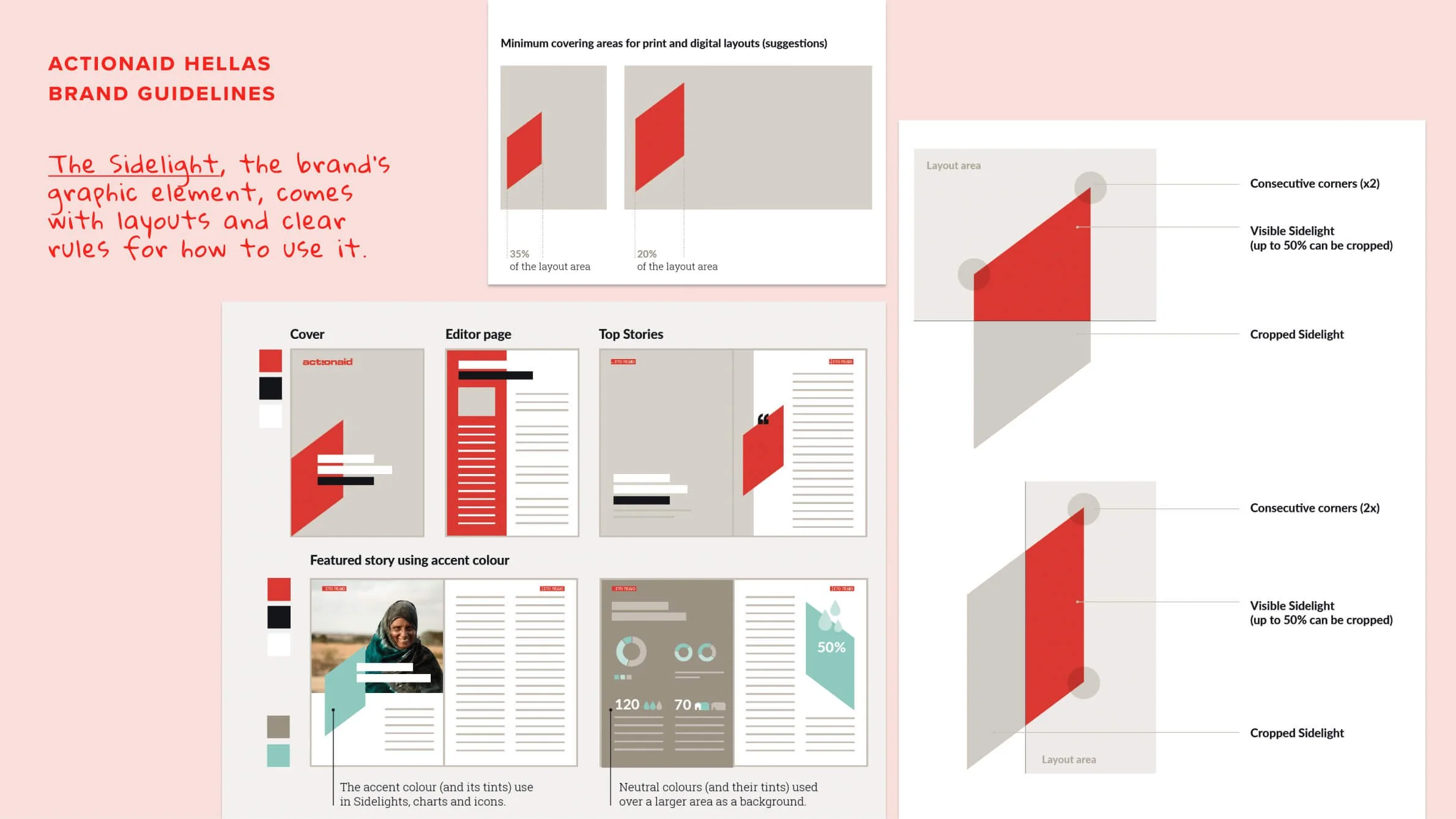
ActionAid Hellas brand guidelines. Some pages extracted from the exhaustive brand guidelines I designed in 2021.
These pages are taken from the guidelines I created for ActionAid Hellas in 2021. They are clear enough that anyone working for the organisation can follow the rules and avoid mistakes, as vitally, they also define what must be avoided.
It is common for companies short on time or budget (or both!) to let AI write their brand guidelines for them. Yet those guidelines should always be reviewed by an experienced brand designer, who can judge where additional rules and constraints will be best-placed.
#2. Layouts need a starting point
When AI creates artwork, it follows best practice so faithfully that the result will always be technically correct. However, it will also be missing something vital: character.
For example, I asked Claude Design to create a poster for my consulting services to hang in my office window. I gave it my design system and a document explaining the offer. The poster was fine in terms of the information offered, but it lacked the clear narrative and quality of my own creative work. My idea – of a seamstress sewing advice into my business – was lost in translation, so the result was just a pair of scissors following a dotted line.
Next, I gave ChatGPT the same input. The result was so close to the ‘seamstress’ metaphor, that anyone spotting the poster from far away would think I had changed jobs and become a tailor! It also displayed far too much information: most people would either give up half-way through reading or ignore it altogether.
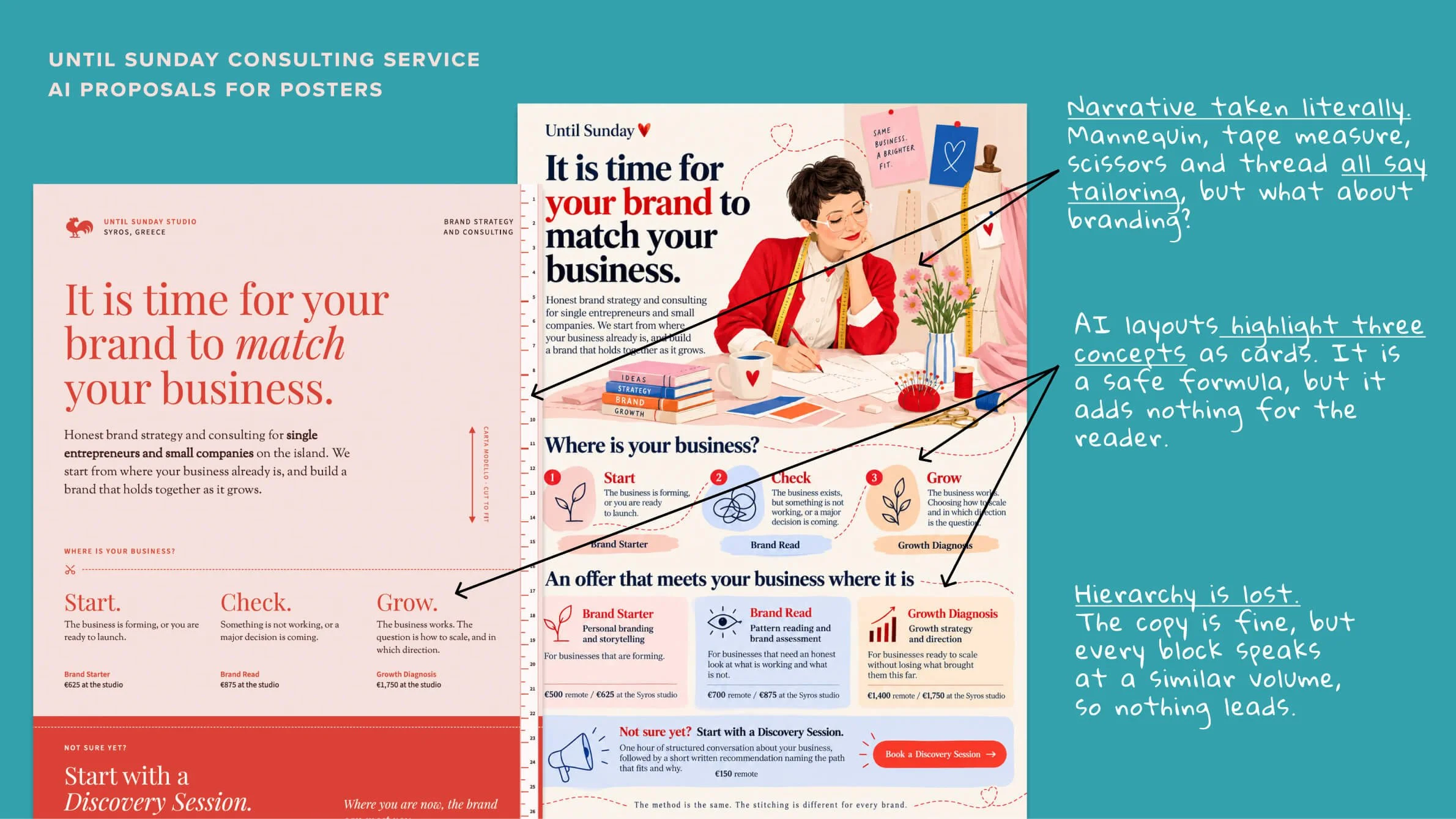
AI-designed posters. The AI-designed posters are generic and could belong to any design studio out there, when in reality my offer is unique and personalised.
Good practice here would be to ask a designer for clean layouts – from landing pages to posters, including brand illustrations and imagery – that AI can use as templates, adapting them to different content and goals. Then, challenge AI as much as you can… but make sure a designer reviews the result.
#2. Layouts need a starting point
In this AI-dominated era, an inspirational mission and vision statement is no longer enough. AI needs actionable inputs to execute tasks in a practical way.
In Design Brands that Last, I teach participants to write a brand promise, along with the values and personality that go with it, in a form AI can read and understand. That way, it can imbue those values and personality into the materials it creates.
I often see people creating two brand essentials with AI: the logo and the company name. If you are a freelancer or small business, you may feel that these are effective ways to save money. But beware, as that logo may look terrible scaled down or printed. Worse still, another company may already hold that amazing business name. These are not things you want to discover further down the road, when the business has grown and it’s hard to turn back.
When AI has no understanding of what the brand stands for, the logo it designs is merely an aesthetic exercise, while the name is no more than random words crammed together. This is because AI cannot interpret emotional implications or narrative. Exploring these takes a designer’s deep knowledge of typography, balance of negative and positive spaces, and storytelling.
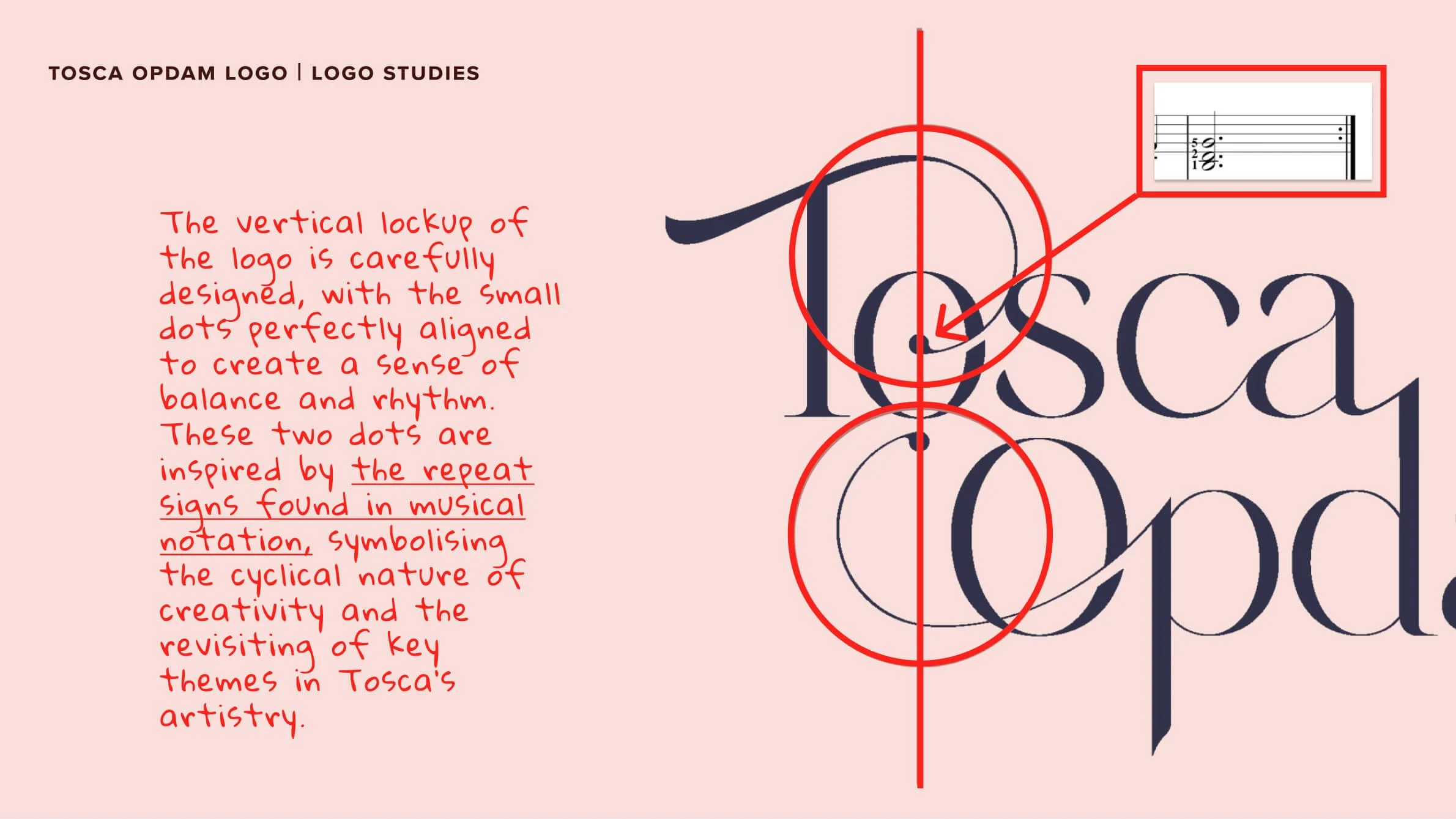
The logo of Tosca Opdam. The logo of this famous Dutch violinist would take many tokens in order to come out with the right balance, elegant strokes and figurative language.
This unique logo, which I designed for the Dutch violinist Tosca Opdam, could not be created by AI because it uses a combination of qualities only a human designer could bring together. For example, AI is unlikely to grasp the idea of a “musical logo” that carries Tosca’s stage presence through shapes taken from a musical score.
Final thoughts
For true AI-readiness, designers must decide where AI genuinely helps and improves the design, and where it needs further directions – or even stay out of the design process altogether. Part of our job is to teach our clients these same insights.
My editor Nina could not find me in the AI-edited text I sent her, and this is exactly what happens when the human steps out of the work. AI may execute commands quickly and technically well, but it is we brand designers who must provide the direction and meaning.
I teach this exact way of thinking in my brand master programme, Design Brands that Last. The next cohort runs in May 2027, and the waitlist is already open.