

#43. Brands that outlast themselves
The first week of Design Brands that Last has just finished, and three more are ahead. What we explored in that opening session was how storytelling elements like audience, purpose and resolution become the foundation of a brand's core.
One concept we ran out of time for, and that I want to give space to here, is resolution. More specifically, the three spheres through which I believe resolution actually happens.
I have written a full article on the difference between purpose and resolution. If you haven't read it yet, start there and then come back.
For those of you who have been following since newsletter 01, and for the students who were in the room last week, what follows picks up from where we paused.

Purpose vs Resolution. Two important elements of the brand core that define its intention and impact.
Resolution, again
The depth of your resolution is what defines how long a brand will last. This is what I taught the students last week. Resolution is the kind of impact a brand has on its audience. In storytelling, resolution is the character arc: the transformation the hero undergoes through the story.
Most resolutions stop at the users a brand touches directly. In fifteen years of working with startups and non-profits, I have rarely seen founders think much beyond their audience and their personas. That is no longer enough.
When a brand enters the world, the ripples it creates are bigger than the impact on its direct users.
I like to push resolution one level further and look at the wider scope of impact. I think about this through three spheres: people, technology and context.
Two is the floor. Three is the top.

Resolutions. The three spheres of impact are people, technology and context.
Two spheres is the floor. A brand that reaches into two of these dimensions, most often people and technology, can build something that lasts. It is difficult, but it is achievable, and most of the brands I have worked with over fifteen years sit here.
Three spheres is the top. A brand that also engages with context, with the cultural and social world it enters, is rare. It is the brand that does not just survive its own ripple. It participates in it.
Sphere 1: People
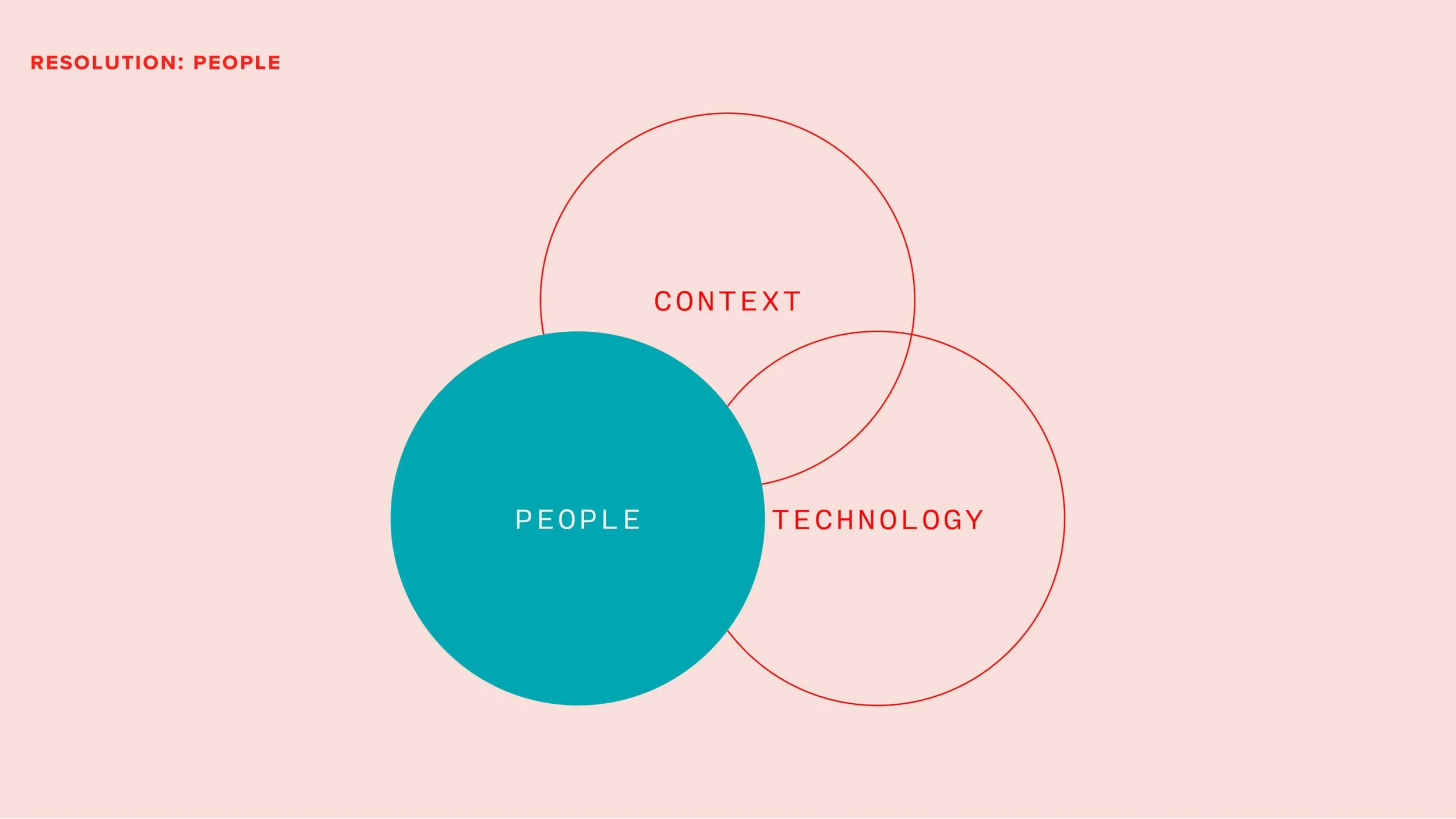
People. The community and society touched by what you build.
The people sphere is larger than your direct target audience. It is the community and society touched by what you build, not just the people who buy from you.
Airbnb is the example I usually reach for, because most of us have used it. Airbnb was born from a specific desire of its founders, to find cheap places to sleep and live a little more like locals. The early ecosystem had two groups, the guest and the host, and for years the business ran on that simple logic. Then the founders understood that to live like a local, you need a wider community. Experiences, guides, shops and places became part of the offer, so the whole stay could feel more rooted.
Today Airbnb includes a much larger group of people, all involved in one idea: making the experience of a place feel lived-in rather than visited.
A different example, closer to my own world, is Vitaly Friedman. For years, Vitaly has been one of the clearest voices teaching how interfaces affect the humans using them, not just the metrics they produce. Twenty years ago, most designers lacked a deep understanding of that relationship. Now, designers who have read his work or sat in his workshops think about people and technology as one question, not two.
The future he is building towards is designers who understand human behaviour deeply enough to make AI systems and interfaces that serve people rather than manipulate them.
When brands reach beyond their direct target group, they grow slowly and organically, and their actions expand.
The real challenge is not breaking the original brand promise on the way. My students understood that part quickly last week. In the real world, it often breaks anyway. When you enlarge your impact to a wider community, the temptation is to forget the community you set out to serve.
Sphere 2: Technology

Technology. How a brand engages with, uses, reshapes or reimagines the tools and systems of its time.
Technology in the frame of resolution is not invention. It is how a brand engages with, uses, reshapes or reimagines the tools and systems of its time. And by doing so, how it teaches others to use technology more humanly and responsibly.
Airbnb is not a tech company in the strict sense. It is a service company that uses the web to connect supply and demand. They built a complex app, powered by algorithms and automation. They did not reinvent technology. They reimagined what existing technology could do between people. That reimagination is a form of technological impact, and perhaps the most lasting kind.
Vitaly's work belongs here too, in a different way. Interface design used to be driven by convention and by copying patterns without understanding why they worked or who they served. Vitaly teaches designers to interrogate the pattern, understand the reasoning, and apply it with judgment rather than habit. The longer effect is products that work better, because the people who built them were taught to question rather than copy.
When brands think about technology, we do not need to become Anthropic or OpenAI. We can be good observers. We can look at how existing technology could serve the community we are building around our brand.
Sphere 3: Context

Context. The cultural and social world the brand operates within.
Context in the frame of resolution is the cultural and social landscape a brand inhabits and, in time, transforms.
I call it context rather than environment deliberately. Environment sits too close to sustainability alone. Context reaches further, into the cultural and social world the brand operates within. (In the book I am writing, this sphere is also referenced as context, not environment.)
Context, as I told my students during the workshop, is difficult to manage, and even harder to predict. That is the whole point of building brands that last. Most brands fail, or end up jeopardised by the same community they nurtured, because they cannot see how to address the changes the brand itself sets in motion as soon as it enters the real world.
Airbnb did a great job on the people sphere, welcoming a wider community. It did very well on technology, building a bridge between supply and demand. What it did not predict or foresee was how the same brand would create new issues in renting, tax regulation and city systems.
Some members of the community Airbnb had nurtured used the model to buy more than one property, running like hotels but without paying taxes like hotels. Small economies and cities were reshaped by the number of houses handed over to the Airbnb business.
On our island, Syros, it is happening at an exponential rate, and locals have started to complain. On the other side, old apartments are being taken and renovated, and the aesthetics of the city are improving because tourists are coming back to visit. These contrasts should not exist. They do because the brand did not treat context as part of its resolution.
Vitaly is different in this respect. In the workshop, when we mapped his resolution, we worked through people and technology together. We stopped before context. Not because his work has no cultural ripple, but because context is the sphere that usually stays open, even for brands doing the other two well. That is part of what the next phase of any long-term brand work has to look at.
For this reason, brands that last usually consider one more factor in their impact: time.
The time factor
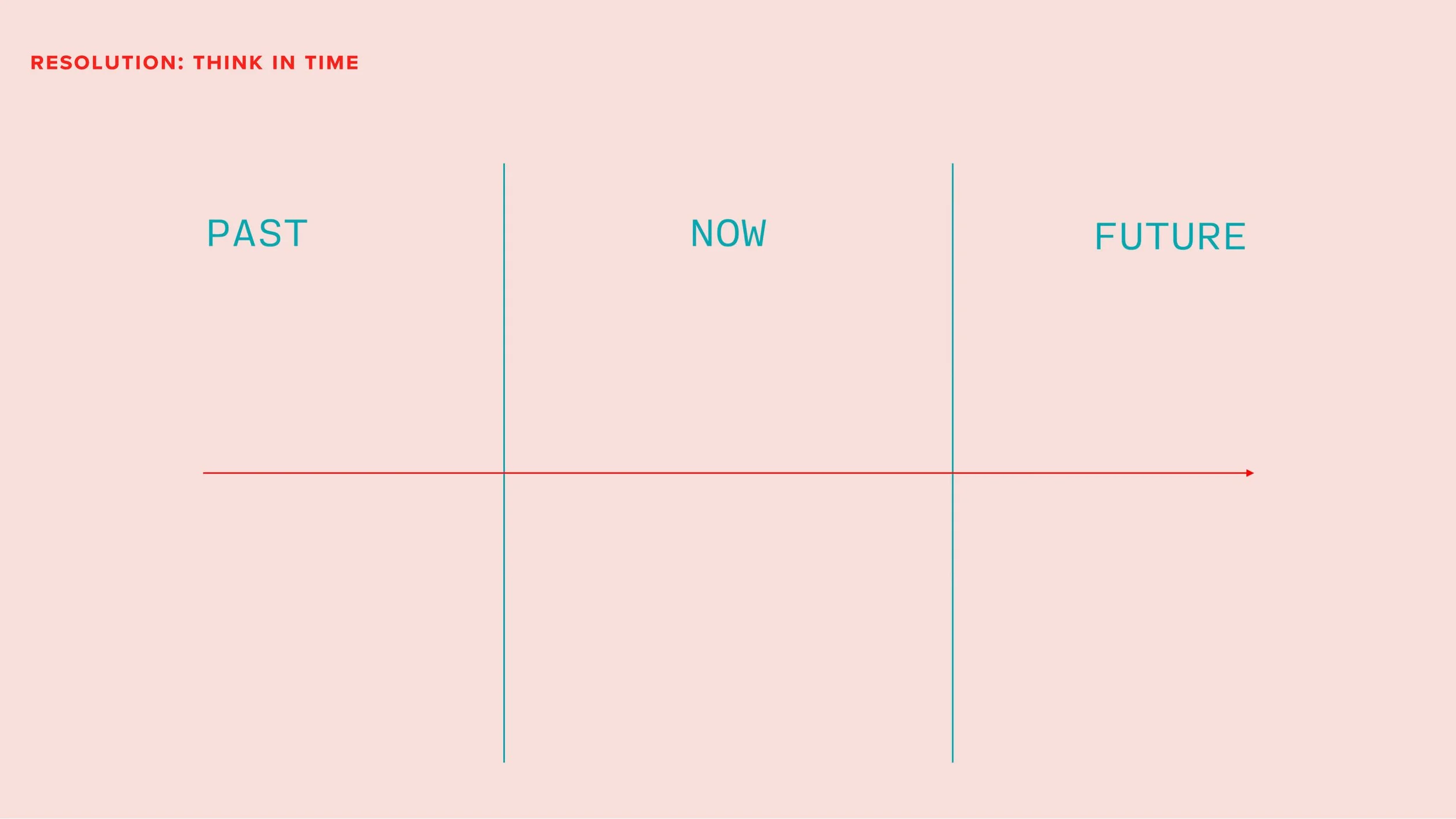
Time. Transformation starts before the brand enters the system, continues while it exists, and carries into the time after it stops being new.
Resolution in a story is transformation. Transformation happens in time. We see it in films, through the character arc. We see it in brands, through the impact they leave.
Looking only at the present is too limited. Transformation starts from a time before the brand enters the system, continues through the time it exists, and carries into the time after it stops being new. Past, now, future.
What I ask clients to do is not the “imagine yourself in five years" exercise. It is to understand which actors are in the brand ecosystem, and to look from the present elements at how things could evolve.
Airbnb was quick to understand that the business could expand and involve a wider community of people. Even those who did not have a house to rent could contribute to making the experience of staying memorable. The context sphere did not seem to be part of the early picture. The brand moved faster than the world around it could follow.
Final thought
What I told my students is this:
The brands that last see their impact across these three spheres, and they see their transformation through time.
Reaching beyond your direct target group opens up opportunities that a narrower view keeps hidden. Technology becomes a way to serve the community forming around your brand, rather than a reason to exist in the first place.
Including context in the equation, especially now in the AI era, is no longer optional. It is necessary, and it is ethically required.
Two spheres is the floor. Three is the top. If you already know which two your brand touches, the question worth sitting with this week is where the third one could come in.